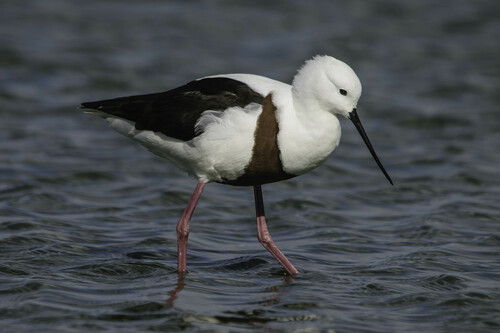
Banded Stilt
Cladorhynchus leucocephalus
Australia’s nomadic master of the salt lakes, the Banded Stilt is a striking wader that appears in the thousands when the desert floods. With its needle-thin legs and vibrant chestnut band, it is a true icon of the Australian outback.
Quick Identification
Size
Length of 35-45 cm (14-18 in) with a wingspan of 75-85 cm (30-33 in); weights range from 190-260 g (6.7-9.2 oz).
Colors
White head and body with jet-black wings; breeding adults feature a prominent chestnut-brown U-shaped breast band, while non-breeding adults may lack it.
Key Features
- Chestnut-brown U-shaped breast band on breeding adults
- Extremely long, flesh-pink legs
- Fine, straight black needle-like bill
- Pied black and white plumage
When You’ll See Them
Geographic range
Where Does the Banded Stilt Live?
The Banded Stilt is a native wanderer of the Australian continent, primarily occupying the southern and western regions. While they are frequently sighted along the coastlines of Western Australia, South Australia, and Victoria, they are famous for their sudden migrations to the arid heart of the country following heavy rains. They are rarely found in the tropical north or the humid forests of the east coast, preferring the salt-rich environments of the southern half of the mainland.
Basemap © OpenStreetMap contributors
Behavior
The Banded Stilt is one of Australia's most fascinating nomads, known for its incredible ability to sense rainfall hundreds of kilometers away. These birds spend much of their time in massive, gregarious flocks, sometimes numbering in the tens of thousands. They are highly social and forage in tight-knit groups, often moving in unison across shallow water like a living carpet of white and black.
Their breeding behavior is legendary; they wait for rare, massive flooding events in the arid interior of Australia. When salt lakes like Lake Eyre fill, the stilts fly inland to breed in enormous colonies before the water evaporates. In their daily life, they are quite wary and will take flight at the slightest disturbance, making them a challenge but a reward to observe from a distance.
EverydayEarth exclusive
Camera Tips
To successfully capture the Banded Stilt on camera, you must focus on their unique saline habitats. Position your camera near the water's edge of a salt lake or coastal lagoon where you see recent tracks or droppings. Use a low-profile ground mount or a very short tripod, aiming for a lens height of 20 to 30 centimeters. This low angle emphasizes their exceptionally long legs and provides a beautiful reflection off the water or salt crust.
Because Banded Stilts are skittish, camouflage is essential. Use a camera housing that matches the white-grey salt flats or light-colored sand. If possible, set up the camera several days in advance to allow the birds to habituate to the object. Avoid using any scent-based lures; instead, look for natural funnels like narrow spits of land or shallow channels where the birds naturally congregate to forage for brine shrimp.
Lightning is your biggest challenge on bright salt flats. To avoid blown-out highlights on their white plumage, underexpose your shots slightly and try to position the camera so the sun is at a 45-degree angle behind you. These birds are active at night, so ensure your camera's infrared flash is high-powered enough to reach 5-10 meters, as they rarely forage right at the very edge of the shore where vegetation might hide predators.
Similar Species
Species that look similar or are commonly confused with Banded Stilt.
Frequently Asked Questions
Record Banded Stilt at your habitat
Connect a camera to start building your own species record — AI identifies every visitor automatically.