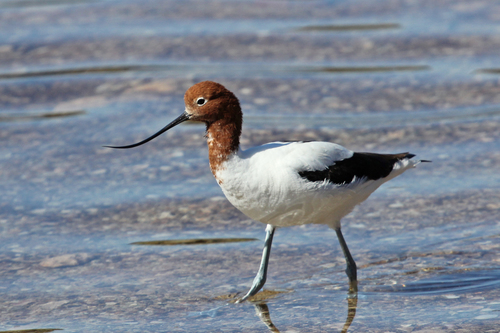
Red-necked Avocet
Recurvirostra novaehollandiae
Meet the 'Painted Lady' of the Australian wetlands, an elegant wader defined by its upturned bill and vibrant crimson head. A master of the shallows, the Red-necked Avocet transforms any shoreline into a display of rhythmic grace.
Quick Identification
Size
Length of 40–48 cm (16–19 in); wingspan of 60–75 cm (24–30 in); weight between 270–390 g (9.5–13.8 oz)
Colors
Striking chestnut-red head and neck; white body; bold black stripes on the wings and back; long, pale blue-grey legs
Key Features
- Long, thin, and distinctly upturned black bill
- Deep chestnut coloration covering the entire head and upper neck
- White eye-ring that is often visible against the red plumage
- Exceptionally long, spindly blue-grey legs for wading
When You’ll See Them
Behavior
The Red-necked Avocet is a highly social and graceful wader, often seen in small groups or massive flocks numbering in the thousands. Their most iconic behavior is their unique feeding method; they wade through shallow water, swinging their long, upturned bills from side to side in a scything motion to stir up and catch tiny aquatic prey. Unlike many other waders, they are also capable of swimming in deeper water, up-ending like ducks to reach food on the bottom.
These birds are nomadic and incredibly responsive to environmental changes. They are known to fly vast distances across the Australian continent to find newly flooded inland salt lakes for breeding. While generally shy around humans, they can become accustomed to observers in suburban wetlands and estuaries, providing a spectacular display of synchronized flight when the flock is startled, showing off their bold black-and-white wing patterns.
EverydayEarth exclusive
Camera Tips
To capture the Red-necked Avocet, camera placement is everything. You want to position your AI camera as low to the ground as possible, ideally at the very edge of a mudflat or shallow pond. Setting the camera just 10–15 centimeters (4-6 inches) above the waterline creates a stunning low-angle perspective that emphasizes their long legs and the unique curve of their bill against the water's reflection. Ensure the camera is angled slightly upward or perfectly horizontal to capture the 'scything' feeding motion at eye level.
Since these birds are highly sensitive to movement, a stationary trail camera is far more effective than handheld photography. Look for 'high-traffic' areas such as the margins of receding waterholes where mud is exposed. While you cannot easily bait avocets with food, you can 'lure' them by maintaining a shallow, sloping muddy bank if you have a large backyard pond. They are attracted to still or slow-moving water where they can easily see their prey.
For camera settings, use a high shutter speed or a 'fast' trigger interval. Avocets move their heads rapidly when feeding, and a slow camera can result in a blurred bill. If your camera allows for video, 30-second clips are ideal for capturing their social interactions and the rhythmic side-to-side motion of their foraging. Early morning light is best, as the rising sun will catch the rich chestnut tones of their neck, making the colors pop against the blue of the water.
Similar Species
Species that look similar or are commonly confused with Red-necked Avocet.
Frequently Asked Questions
Record Red-necked Avocet at your habitat
Connect a camera to start building your own species record — AI identifies every visitor automatically.