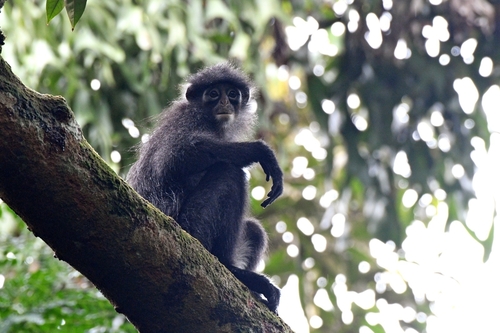
Banded Surili
Presbytis femoralis
Meet the 'ghost of the forest,' a critically endangered primate with a striking black-and-white coat found only in Singapore and southern Malaysia.
Quick Identification
Size
Head-body length of 43–61 cm (17–24 in) with a long tail of 61–84 cm (24–33 in); weight ranges from 5.9–8.2 kg (13–18 lbs).
Colors
Predominantly jet-black or dark charcoal-grey fur; striking white band running down the center of the chest, abdomen, and inner thighs; pale greyish rings around the eyes.
Key Features
- Long, slender limbs and exceptionally long tail
- Distinctive white vertical stripe on the belly and inner thighs
- Dark face with pale, mask-like eye rings
- Arboreal specialist that rarely touches the ground
When You’ll See Them
Geographic range
Where Does the Banded Surili Live?
Native to the Southeast Asian tropics, the Banded Surili is found exclusively in a very restricted range at the southernmost tip of the Malay Peninsula. Its core populations are located within the Central Catchment Nature Reserve in Singapore and fragmented forest patches in the Malaysian states of Johor and Pahang. This species is a true regional specialist and does not exist in any introduced populations outside this small, vulnerable geographic corridor.
Basemap © OpenStreetMap contributors
Behavior
The Banded Surili, also known as the Raffles' Banded Langur, is an incredibly shy and elusive tree-dwelling primate. Unlike more common urban monkeys, they are strictly arboreal and spend nearly their entire lives in the high canopy. They typically live in small, cohesive family groups of 3 to 14 individuals, led by a single dominant male who protects the group and scouts for safe passage between trees.
These primates are known for their 'rattling' alarm calls and high-pitched vocalizations used to maintain group contact in dense foliage. They are highly sensitive to human presence and habitat fragmentation; if they detect an intruder, they will often freeze or move silently into the thickest part of the canopy rather than approaching. Their daily routine is split between active foraging periods and long bouts of resting to allow their complex stomachs to ferment and digest fibrous leaves.
EverydayEarth exclusive
Camera Tips
Capturing the Banded Surili requires height and patience, as they are strictly arboreal and rarely descend to the forest floor. To increase your chances, mount your AI-powered camera at least 10 to 20 feet up in the canopy, specifically targeting 'high-traffic' branches or natural bridges where the canopy closes over trails. Look for horizontal limbs with worn bark or spots where trees from different species intersect, as these are often used as regular travel routes for the troop.
Since these monkeys are primarily leaf-eaters, traditional ground-based baits like fruit or corn are ineffective and may actually attract unwanted macaques that scare the Surilis away. Instead, focus on placement near their preferred food sources, such as trees flushing with young, reddish-tinted leaves. If you are in a property bordering a nature reserve, maintaining a 'canopy bridge' of tall native trees like the Salam tree (Syzygium polyanthum) can act as a natural lure to bring them within camera range.
Adjust your camera settings for high-speed motion and difficult lighting. Surilis are incredibly fast jumpers, and a slow shutter speed will result in nothing but a black blur against the sky. Use a 'burst mode' or high-frame-rate video setting (at least 60fps) to catch the detail of their white belly stripes as they leap. Because they are most active in the early morning when light is dappled, ensure your camera has a high-quality sensor to prevent silhouettes against the bright morning sun.
Similar Species
Species that look similar or are commonly confused with Banded Surili.
Long-tailed Macaque
Macaques have brownish fur and a shorter tail relative to their body, and they are frequently seen on the ground or near humans.
Robinson's Banded Langur
A closely related species found in northern Malaysia and Thailand that lacks the specific white underbelly patterns of the Raffles' Banded Surili.
Frequently Asked Questions
Record Banded Surili at your habitat
Connect a camera to start building your own species record — AI identifies every visitor automatically.