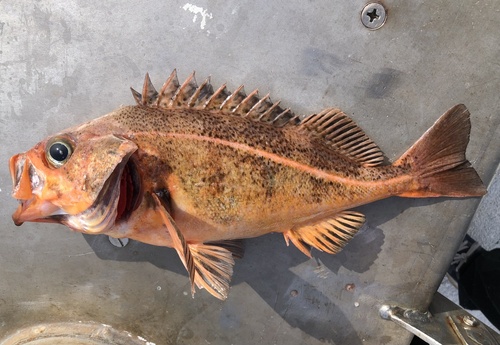
Bank Rockfish
Sebastes rufus
A vibrant resident of the Pacific's deep rocky banks, the Bank Rockfish stands out with its striking rusty-red hue and signature black spots. Often found in large schools, this deep-water specialist is a testament to the hidden biodiversity of the California current.
Quick Identification
Size
Typically 30-38 cm (12-15 inches), reaching a maximum length of 51 cm (20 inches) and weighing up to 1.5 kg (3.3 lbs).
Colors
Body is primarily rusty red, brownish-orange, or olive-green, covered in numerous small black spots that extend onto the dorsal and caudal fins.
Key Features
- Distinct small black spots peppered across the body and fins
- Prominent spines on the head and gill covers
- Deep-bodied, oval profile with a large, expressive eye
- Uniformly pale or white belly contrasting with a dark reddish back
When You’ll See Them
Geographic range
Where Does the Bank Rockfish Live?
Native to the Eastern Pacific Ocean, the Bank Rockfish is found along the western coast of North America. Its primary range extends from the chilly waters off San Francisco, California, southward to the central regions of Baja California, Mexico. This species is a deep-water specialist, favoring the rugged topography of offshore banks and islands over the shallow tidal zones found closer to the mainland.
Basemap © OpenStreetMap contributors
Behavior
The Bank Rockfish is a social and gregarious species, often forming large, loose schools over deep-water rocky banks and continental shelf slopes. Unlike some of its more reclusive relatives that hide in deep crevices, the Bank Rockfish is frequently observed hovering several meters above the seafloor. This mid-water positioning allows them to take advantage of nutrient-rich currents that sweep prey across the underwater ridges.
These fish are known for their longevity and slow maturation, a hallmark of the rockfish family. They are relatively docile and show little fear toward submersibles or remotely operated vehicles (ROVs), making them a primary subject for deep-sea biological studies. Their social interactions are largely centered around communal feeding and protection in numbers within the vast, dark expanses of the Pacific twilight zone.
EverydayEarth exclusive
Camera Tips
Capturing the Bank Rockfish requires specialized underwater technology, as their habitat begins well below the depths reachable by casual divers. For enthusiasts using ROVs or deep-drop camera housings, the best results are achieved by targeting the peaks of offshore rocky banks. Look for areas with high vertical relief—underwater cliffs and large boulder piles—as these structures attract the largest aggregations of fish.
Lighting is the most critical factor in deep-sea photography. Because the red end of the light spectrum is absorbed quickly in deep water, Bank Rockfish will look brown or grey without powerful external LED arrays. Use wide-angle video lights positioned away from the camera lens to minimize the reflection of 'marine snow' (floating organic debris), which can otherwise obscure the frame. High-intensity lights will bring out the brilliant rusty-red color and the fine black spots that define this species.
To draw Bank Rockfish toward your camera for a close-up, utilize a perforated bait canister. Oily baits like chopped squid or sardines are highly effective, as the scent trail carries far in the deep-sea currents. Once a few fish investigate, the rest of the school often follows. Ensure your camera is set to a high bitrate to capture the delicate movement of their fins as they stabilize themselves against the current, and use a tripod mount or heavy ballast to keep the camera steady on the seafloor.
Similar Species
Species that look similar or are commonly confused with Bank Rockfish.
Frequently Asked Questions
Record Bank Rockfish at your habitat
Connect a camera to start building your own species record — AI identifies every visitor automatically.