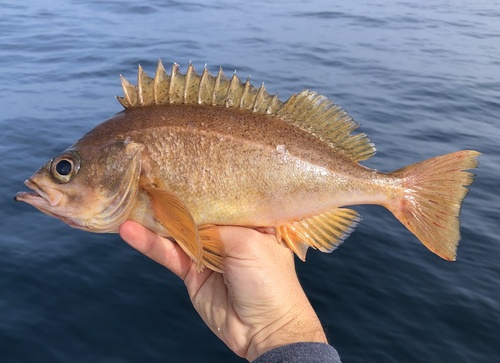
Speckled rockfish
Sebastes ovalis
A master of the deep-water reefs, the Speckled rockfish is easily identified by the thousands of tiny dark spots that dance across its tan body. These social fish are a cornerstone of the Pacific's rocky ecosystems, often found schooling in the current above submerged mountain ranges.
Quick Identification
Size
12 to 22 inches (30 to 56 cm); weight typically ranges from 1 to 3 lbs (0.5 to 1.4 kg)
Colors
Tan, yellowish-brown, or olive-green body heavily covered with small black spots; clear lateral line; whitish belly
Key Features
- Body and fins covered in fine black speckles
- Distinctly clear or light-colored lateral line
- Deeply notched dorsal fin with sharp spines
- Large, dark eyes adapted for low-light depths
When You’ll See Them
Geographic range
Where Does the Speckled rockfish Live?
The Speckled rockfish is a native resident of the Eastern Pacific Ocean, specifically concentrated along the western coast of North America. Its primary range begins in the temperate waters off San Francisco, California, and extends southward to central Baja California, Mexico. These fish are most commonly encountered in the Southern California Bight, where the complex underwater topography of the Channel Islands provides the rocky shelter they crave.
Basemap © OpenStreetMap contributors
Behavior
Speckled rockfish are highly social marine fish known for forming mid-water schools. Unlike many of their rockfish cousins who prefer to rest directly on the seafloor, Speckled rockfish are more active swimmers, often found hovering several meters above rocky reefs and deep-water pinnacles. They are diurnal hunters, utilizing the daylight hours to pick out individual prey from the water column.
In terms of social structure, they frequently mix with other species, such as the Square-spot or Widow rockfish. While they are generally wary of large disturbances, they are curious enough to investigate slow-moving underwater ROVs. They have a slow growth rate and can live for several decades, a common trait among the Sebastes genus that makes them sensitive to overfishing.
EverydayEarth exclusive
Camera Tips
Capturing the Speckled rockfish requires specialized underwater equipment, as they reside far deeper than standard backyard ponds. For those using underwater drop-cameras or Remotely Operated Vehicles (ROVs), the best results come from targeting 'high-relief' areas—underwater cliffs, boulders, and pinnacles. Position your camera to face into the prevailing current, as these fish naturally orient themselves upstream to catch drifting food.
Lighting is the most critical factor at these depths. Avoid using a single, direct 'flat' light which can wash out the subtle speckling that gives this species its name. Instead, use dual-point lighting mounted on arms to create shadows and highlights, which better defines the fish's texture. Because Speckled rockfish are often found in schools, a wide-angle lens is recommended to capture the group's social dynamics rather than a single individual.
If you are using a stationary baited camera (a 'BRUV'), place a mesh bag containing chopped squid or sardines near the lens. While Speckled rockfish are plankton eaters, the 'marine snow' created by the bait will attract them and their schooling companions. Set your camera for a high frame rate (at least 60fps) to counteract the movement of the water and ensure the fine details of their spotted fins remain sharp in your footage.
Similar Species
Species that look similar or are commonly confused with Speckled rockfish.
Frequently Asked Questions
Record Speckled rockfish at your habitat
Connect a camera to start building your own species record — AI identifies every visitor automatically.