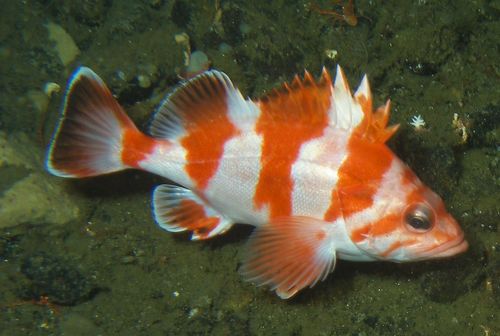
Redbanded Rockfish
Sebastes babcocki
Often called the 'Barber Pole' of the Pacific, the Redbanded Rockfish is a stunning deep-sea dweller known for its bold crimson stripes and incredible longevity. This long-lived sentinel of the rocky reefs offers a vibrant glimpse into the mysterious world of the North Pacific depths.
Quick Identification
Size
Typically reaches 30-50 cm (12-20 inches), with a maximum length of 64 cm (25 inches) and weight up to 4.4 kg (9.7 lbs).
Colors
Body is primarily white to pale pink with 4-5 distinctive vertical red or orange-red bands; the first band usually runs through the eye.
Key Features
- 4-5 bold vertical red or pink bands
- Deeply notched dorsal fin
- First band passes through the eye
- Heavy, stocky body with a large head
When You’ll See Them
Behavior
The Redbanded Rockfish is a largely solitary and sedentary species, preferring to spend its time hovering near the sea floor or tucked into the crevices of rocky reefs. Unlike more social schooling fish, these 'bandits' are territorial and tend to stay in one specific area for long periods, often resting their pectoral fins directly on the substrate. They are incredibly long-lived, with some individuals estimated to be over 100 years old, moving at a slow, deliberate pace that reflects their longevity.
In terms of social interaction, they are generally indifferent to other species unless they are perceived as prey or a direct threat to their crevice. When approached by divers or ROVs, they often remain motionless, relying on their bold stripes to break up their silhouette against the complex backdrop of the reef. This stillness makes them excellent subjects for observation, provided you can reach their deep-water haunts.
EverydayEarth exclusive
Camera Tips
Capturing the Redbanded Rockfish requires a departure from standard backyard setups, as this is a deep-sea species. To see them, you will need a tethered underwater camera or a Baited Remote Underwater Video (BRUV) system. Because these fish live in high-pressure environments at depths where natural light is filtered out, high-powered LED floodlights are non-negotiable. Without artificial light, the striking red bands will appear grey or black; you need a light source with a high Color Rendering Index (CRI) to bring out those iconic 'barber pole' colors.
Position your camera near 'high-relief' structures—areas where the seafloor is not flat but consists of large boulders, ledges, or pinnacles. Redbanded Rockfish love the edges where rock meets sand. Use a weighted tripod or a heavy camera housing to ensure the unit doesn't drift with deep-sea currents. If you are using a stationary drop-cam, aim the lens slightly upward from the seafloor or directly at a rocky crevice, as these fish often hover just inches above the bottom.
Bait is the most effective way to bring a Redbanded Rockfish into your camera's field of view. Secure a mesh 'chum bag' filled with oily fish like chopped herring, sardines, or squid about two feet in front of the lens. The scent will draw them out from their hiding spots. Since these fish are slow movers, you can set your camera to a lower frame rate (like 24 or 30 fps) to save battery and storage, but keep your ISO settings flexible to handle the contrast between your lights and the dark abyss.
Timing is less about the sun and more about water clarity. In the North Pacific, visibility is often best in the late summer and autumn when the spring plankton blooms have died off and settled. Avoid deployment immediately after major storms, as the 'marine snow'—falling organic debris—will reflect your camera lights and create a grainy, clouded image. For the best results, look for calm surface conditions that allow for a steady drop and clear transmission of the video feed.
Similar Species
Species that look similar or are commonly confused with Redbanded Rockfish.
Frequently Asked Questions
Record Redbanded Rockfish at your habitat
Connect a camera to start building your own species record — AI identifies every visitor automatically.