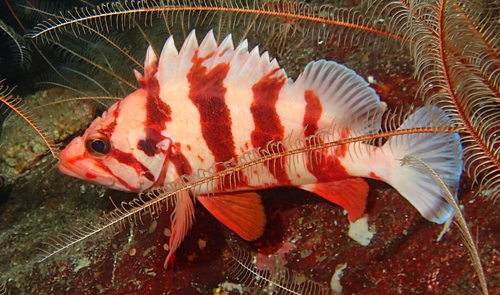
Tiger Rockfish
Sebastes nigrocinctus
The tiger rockfish is a solitary sentinel of the deep, known for its striking vertical stripes and its habit of guarding the same rocky crevice for decades.
Quick Identification
Size
Grows up to 61 cm (24 inches) in length and can weigh up to 2.2 kg (4.8 lbs).
Colors
Creamy white to light pink base with 5-6 bold, vertical black or dark crimson bands; dark stripes often radiate from the eyes.
Key Features
- Five to six distinct vertical dark bands
- Large, spiny dorsal fin
- Stout, heavy-set body
- Two dark stripes extending backwards from the eyes
When You’ll See Them
Behavior
The tiger rockfish is a notorious homebody of the Pacific reef. Unlike many other rockfish species that school in mid-water, the tiger rockfish is solitary and highly territorial. It selects a specific crevice or cave within a rocky reef and may stay within a few meters of that "den" for its entire adult life. They are ambush predators, often found hovering motionlessly near their retreat, waiting for prey to drift or scuttle by.
These fish are exceptionally long-lived, with some individuals reaching ages over 100 years. Because of their sedentary nature, they are often indifferent to divers and underwater cameras, though they will quickly retreat into their cracks if they feel threatened. They do not migrate, making them a reliable species to observe if you can locate their specific habitat.
EverydayEarth exclusive
Camera Tips
Capturing a tiger rockfish requires a specialized underwater camera setup or a "drop-cam" positioned near rocky structures. To find them, look for "high-relief" environments—areas with large boulders, deep cracks, or underwater cliffs. These fish are extremely site-faithful; if you spot one on camera, it is likely living in a crevice within a few feet of that spot. Position your camera on a weighted tripod at a 45-degree angle to a promising crevice rather than pointing directly into the dark hole, which can trick the camera's exposure settings.
Lighting is the most critical factor for a clear shot. At the depths tiger rockfish prefer, red light is filtered out by the water, making them look grey or brown. Use a camera with high-CRI (Color Rendering Index) external video lights to reveal their true crimson and black banding. Setting your AI camera to trigger on "slow movement" is beneficial, as these fish move with deliberate, subtle motions and often hover perfectly still for long periods.
For the best results, deploy your camera during periods of high water clarity, typically during the winter months in the Pacific Northwest when plankton blooms are minimal. Avoid using bait bags directly in front of the lens, as this can attract swarms of smaller "baitfish" or crabs that will obstruct the view and trigger the camera constantly. Instead, place the camera near a natural clearing where the rockfish is likely to emerge to survey its territory.
Similar Species
Species that look similar or are commonly confused with Tiger Rockfish.
Frequently Asked Questions
Record Tiger Rockfish at your habitat
Connect a camera to start building your own species record — AI identifies every visitor automatically.