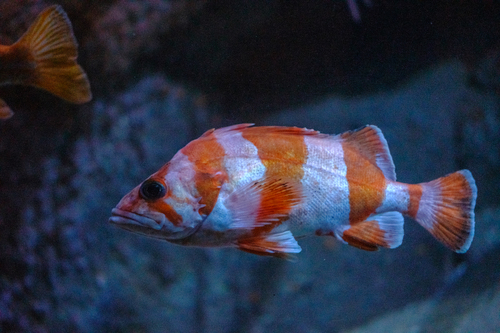
Flag Rockfish
Sebastes rubrivinctus
With its striking 'barberpole' stripes and stoic personality, the Flag Rockfish is a vibrant master of the Eastern Pacific's deep-water reefs.
Quick Identification
Size
Typically 10-15 inches (25-38 cm), but can reach up to 20 inches (51 cm) and weigh up to 5 lbs (2.3 kg)
Colors
Brilliant alternating vertical bands of crimson red and creamy white or pale pink; the red bands are usually narrower toward the belly.
Key Features
- Vertical 'barberpole' red and white stripes
- Deeply notched dorsal fin with sharp spines
- Bony, spiny head with large eyes
- Stocky, compressed body shape
When You’ll See Them
Geographic range
Where Does the Flag Rockfish Live?
Native to the nutrient-rich waters of the Eastern Pacific, the Flag Rockfish is a cornerstone species of the coastal deep. Its range extends from the chilly northern waters off British Columbia, Canada, through the entire West Coast of the United States, and down into the warmer subtropics of Baja California, Mexico. They are most frequently encountered along the California coastline where underwater canyons and rocky outcroppings provide the perfect vertical architecture for their sedentary lifestyle.
Basemap © OpenStreetMap contributors
Behavior
The Flag Rockfish is a relatively sedentary and solitary resident of the deep reef. Unlike some schooling fish, these rockfish prefer to claim a specific territory among rocky crevices or boulder fields. They are classic ambush predators, often hovering motionless just above the seafloor or tucked inside a cave, waiting for unsuspecting prey to drift within striking distance. Their vibrant 'flag' pattern actually serves as disruptive coloration in the dim light of deeper waters, breaking up their silhouette against the complex shadows of the reef.
As members of the Sebastes genus, they are remarkably long-lived, with some individuals potentially reaching 40 to 50 years of age. They are non-migratory, often spending their entire adult lives within a very small area. While they generally ignore divers or underwater cameras, they are highly sensitive to sudden pressure changes and vibrations in the water. In the presence of humans, they tend to retreat slowly into the safety of rock formations rather than fleeing at high speed.
EverydayEarth exclusive
Camera Tips
Capturing the Flag Rockfish requires a specialized underwater camera setup, as they typically live at depths beyond the reach of standard backyard gear. If you have access to a dock, pier, or a boat over a rocky reef, an underwater drop-camera with a weighted cable is your best bet. Because red light is the first color to be absorbed by water, these fish will look grey or brown at depth unless you provide artificial lighting. High-lumen LED lights with a high Color Rendering Index (CRI) are essential to bring out those iconic crimson stripes in your footage.
Since Flag Rockfish are ambush predators, they are highly attracted to scent. Using a perforated bait canister filled with smashed squid, mackerel, or fish oil attached near the camera lens will draw them out from their rocky hiding spots. Position your camera so it is facing a vertical rock face or a crevice; these fish love to hover near 'relief' in the seafloor rather than open sandy flats.
For the best results, set your camera to record in 4K with a high frame rate if possible, as their movements are subtle. Stability is key—if you are dropping a camera from a boat, use a finned housing to prevent the current from spinning the camera, which can produce dizzying footage and scare away the fish. Early morning or late afternoon provides the best ambient light to supplement your LEDs, creating a more natural look for your underwater wildlife photography.
Similar Species
Species that look similar or are commonly confused with Flag Rockfish.
Redbanded Rockfish
The red bands on the Redbanded Rockfish are typically wider at the bottom, whereas the Flag Rockfish's bands narrow toward the belly.
Tiger Rockfish
Tiger Rockfish have dark, nearly black or dark-grey bands rather than the bright crimson-red bands found on the Flag Rockfish.
Treefish
Treefish have yellowish bodies with dark vertical bands and distinct thick red lips, lacking the clean red-and-white 'flag' pattern.
Frequently Asked Questions
Record Flag Rockfish at your habitat
Connect a camera to start building your own species record — AI identifies every visitor automatically.