Treefish
Sebastes serriceps
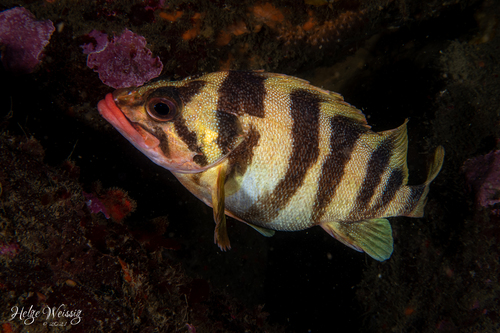
A vibrant sentinel of the kelp forest, the Treefish is easily recognized by its bold 'bumblebee' stripes and bright pink lips. These territorial rockfish are the colorful masters of the Pacific's rocky underwater canyons.
Quick Identification
Size
Typically 10-14 inches (25-35 cm), reaching a maximum of 16 inches (41 cm); weight up to 4 lbs (1.8 kg).
Colors
Bright yellowish-green to olive-yellow body with 5-6 thick vertical black bands; distinctive pink or reddish tint on the lips and fin membranes.
Key Features
- 5-6 prominent vertical black bars across a yellow body
- Fleshy pink or red lips
- Heavy, venomous spines on the dorsal fin
- Large, rounded pectoral fins and a stocky rockfish profile
When You’ll See Them
Behavior
The Treefish is a notoriously territorial resident of the Pacific rocky reefs. Unlike many of its rockfish cousins that school in open water, the Treefish is a solitary homebody. It claims a specific crevice or 'cave' within the rocks and will aggressively defend this small patch of territory from intruders, including larger fish. During the day, they are often seen resting motionless near the entrance of their lair or hovering just above the substrate, waiting for an easy meal to drift by.
Despite their bold appearance, they are ambush predators. They rely on the broken silhouette provided by their vertical stripes to blend into the shadows of kelp forests and rocky overhangs. While they are generally wary of divers, their strong attachment to a home site makes them excellent subjects for observation if approached slowly. They are most active during the twilight hours, though they remain alert and visible throughout the day.
EverydayEarth exclusive
Camera Tips
Capturing the Treefish requires a specialized underwater camera setup, such as a GoPro or a dedicated submersible AI camera. Because Treefish are highly territorial and cling to specific rocky real estate, the most effective strategy is to locate a 'resident' fish first. Look for rocky crevices or man-made breakwaters with deep cracks. Once you spot a Treefish retreating into a hole, you have found the perfect spot for a stationary camera mount. Use a weighted tripod or a heavy suction mount to ensure the camera doesn't shift with the surge or tide.
Lighting is your biggest challenge underwater. To capture the brilliant yellow and pink hues of the Treefish, you will need an external video light or a red filter to compensate for the loss of color at depth. Position your lights at a 45-degree angle away from the lens to minimize 'backscatter'—the reflection of light off particles in the water. Since Treefish are ambush predators, they often remain still for long periods; setting your camera to a higher frame rate (60fps or higher) will help you capture the sudden, explosive movement when they strike at prey.
For baiting in areas where it is legally permitted, a small mesh bag filled with crushed sea urchin or oily fish like mackerel can be tied near the camera. This will not only attract the Treefish out of its crevice but also draw in the small crustaceans they prey upon, creating a high-action scene. Ensure your camera is set to a wide-angle view to capture the surrounding reef context, and if your AI software allows, set a 'motion zone' specifically at the mouth of the crevice to avoid wasting battery on moving kelp fronds.
Similar Species
Species that look similar or are commonly confused with Treefish.
Black-and-Yellow Rockfish
Lacks the vertical banding of the Treefish, instead featuring a mottled black body with large yellow spots.
Tiger Rockfish
Found in deeper, colder water with reddish-pink vertical bands rather than the Treefish's yellow and black.
Gopher Rockfish
Has a more brownish base color with light-colored spots and lacks the bold vertical black bars.
Frequently Asked Questions
Record Treefish at your habitat
Connect a camera to start building your own species record — AI identifies every visitor automatically.