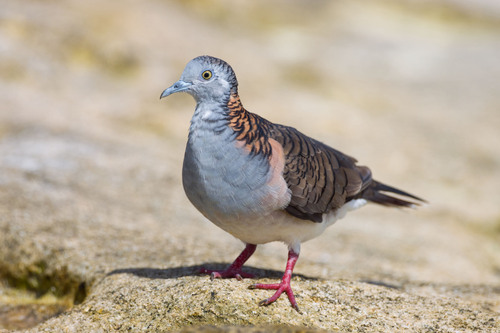
Bar-shouldered Dove
Geopelia humeralis
Recognized by the striking 'scaly' pattern on its neck and its melodic 'cook-a-wook' call, the Bar-shouldered Dove is a charismatic visitor to Australian coastal gardens. This ground-loving bird is a master of the suburbs, often found strutting through backyards in search of seeds.
Quick Identification
Size
Length: 26–30 cm (10–12 in); Weight: 110–140 g (3.9–4.9 oz)
Colors
Blue-grey head and breast; bronze-brown wings with fine black barring; copper-bronze patch on the nape; pale eye ring
Key Features
- Distinctive dark barring on the back of the neck and shoulders
- Long, graduated tail with white-tipped outer feathers
- Blue-grey breast and throat
- Copper-bronze patch on the nape (back of the neck)
When You’ll See Them
Geographic range
Where Does the Bar-shouldered Dove Live?
This species is native to the Oceania region, predominantly found across Northern and Eastern Australia as well as Southern New Guinea. Its range extends from the Kimberley region in Western Australia, across the Top End, and down the entire eastern coast through Queensland to Southern New South Wales. Unlike many other Australian doves, it is rarely found far from the coast or major inland river systems.
Basemap © OpenStreetMap contributors
Behavior
The Bar-shouldered Dove is a social and ground-dwelling bird often seen in pairs or small groups. They are known for their characteristic nodding head motion while walking, a behavior typical of pigeons as they scan the ground for seeds. While they are relatively shy in the wild, they have adapted remarkably well to suburban environments and can become quite tame around backyard feeders and water stations.
These doves are famous for their melodious vocalizations, often described as a rhythmic 'cook-a-wook' or 'coolicoo'. During the breeding season, males perform elaborate courtship displays, which include bowing towards the female while fanning out their tails to display the white outer feathers. They are mostly sedentary, remaining in the same general territory year-round as long as food and water are available.
EverydayEarth exclusive
Camera Tips
To capture the best footage of Bar-shouldered Doves, mount your AI camera at a low height, approximately 15 to 30 centimeters (6-12 inches) above the ground. Since these birds spend the vast majority of their time foraging on the floor, a ground-level perspective provides the most intimate and detailed views of their intricate 'scaly' feather patterns. Position the camera near a patch of bare earth or short grass where they are likely to search for seeds.
Water is a significant draw for this species. Placing a shallow, ground-level birdbath in the camera's field of view is one of the most effective ways to ensure daily visits. They prefer to drink in the early morning and late afternoon, so ensure your camera is positioned to avoid lens flare during these golden hours. If you are using seed as a lure, small grains like millet or birdseed mixes scattered in a consistent spot will encourage them to establish a routine visit.
For camera settings, use a high trigger sensitivity and a fast shutter speed if possible, as their head-nodding walk and quick pecking motions can sometimes cause motion blur. Using a video mode with at least 30fps will help capture their rhythmic calls and social interactions. In summer months, they visit water more frequently, making it the peak season for high-action captures at watering stations.
Similar Species
Species that look similar or are commonly confused with Bar-shouldered Dove.
Peaceful Dove
Much smaller in size with blue-grey skin around the eye and no copper patch on the neck.
Spotted Dove
An introduced species with a prominent black-and-white spotted patch on the side of the neck rather than bronze barring.
Diamond Dove
Much smaller and slimmer with white spots on the wings and a bright red eye-ring.
Frequently Asked Questions
Record Bar-shouldered Dove at your habitat
Connect a camera to start building your own species record — AI identifies every visitor automatically.