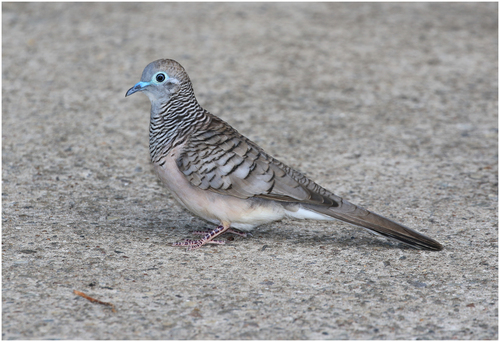
Peaceful Dove
Geopelia placida
With its soothing rhythmic coo and striking blue eye-rings, the Peaceful Dove is a master of suburban serenity. This petite, barred beauty is a favorite for backyard observers, offering a glimpse into the quiet life of Australia's native pigeons.
Quick Identification
Size
Length: 19–21 cm (7.5–8.3 inches); Weight: 40–60 g (1.4–2.1 oz)
Colors
Upperparts are soft grey-brown with fine black barring; face and breast are blue-grey; belly is creamy white; notable bright blue skin around the eye.
Key Features
- Distinctive blue orbital ring around the eye
- Fine black horizontal barring on the neck and chest
- Small, slender body with a long, white-edged tail
- Pinkish-grey legs and feet
When You’ll See Them
Behavior
The Peaceful Dove is a gentle, ground-dwelling bird often seen in pairs or small family groups. They are remarkably relaxed around humans, often foraging just a few feet away from garden patios. Their movement is characterized by a rhythmic nodding of the head as they walk, searching for tiny seeds among the grass. You will frequently hear them before you see them; their signature three-note call, which sounds like 'doodle-doo' or 'pleas-ant-work,' is a staple sound of the Australian morning.
Socially, these doves are monogamous and maintain strong pair bonds. During courtship, the male performs an elaborate display involving bowing and spreading his tail to reveal the white outer feathers. While they spend most of their daylight hours on the ground, they retreat to the safety of dense shrubs or low tree branches when threatened or to roost for the night.
EverydayEarth exclusive
Camera Tips
To capture the best footage of Peaceful Doves, place your camera at a very low vantage point, ideally 10–15 centimeters (4–6 inches) off the ground. Because these birds spend almost all their active time foraging on the earth, a ground-level ‘eye-to-eye’ angle provides a much more intimate and professional look than shooting from a downward angle. Position the camera near a patch of bare earth or short-cropped grass where you have seen them scratching around previously.
Water is a massive drawcard for this species. Unlike many birds that take quick sips, Peaceful Doves—like most pigeons—can suck up water continuously, leading to longer stays at a birdbath. Setting your camera near a low-profile water dish or the edge of a pond will almost guarantee daily visits. If you are using a trigger-based camera, set the sensitivity to high, as their small size and relatively slow walking pace can sometimes fail to trip less sensitive PIR sensors.
If you want to encourage them to stay in frame longer, scatter a handful of fine 'finch mix' or small birdseed in a 1-meter radius around your camera's focal point. Avoid using large grains like corn or sunflower seeds, as these doves have small beaks and prefer tiny grass seeds. Early morning light is particularly flattering for their blue eye-rings and delicate barring, so try to face your camera north or south (in the southern hemisphere) to avoid the direct glare of the rising sun.
Consider using a high frame rate (60fps or higher) if your camera allows. Peaceful Doves often engage in rapid wing-flicking or sudden bursts of flight when startled, and capturing these movements in slow motion can reveal the beautiful white patterns on their tail feathers that are usually a blur to the naked eye. Ensure the area in front of the lens is clear of tall grass blades, which can cause focus hunting or false triggers on windy days.
Similar Species
Species that look similar or are commonly confused with Peaceful Dove.
Diamond Dove
Smaller with distinctive white 'diamond' spots on the wings and a bright red eye-ring instead of blue.
Zebra Dove
Nearly identical but found in SE Asia; it has more extensive barring on the underparts and a slightly different call.
Bar-shouldered Dove
Significantly larger with a copper-colored patch on the back of the neck and a blue-grey face.
Frequently Asked Questions
Record Peaceful Dove at your habitat
Connect a camera to start building your own species record — AI identifies every visitor automatically.