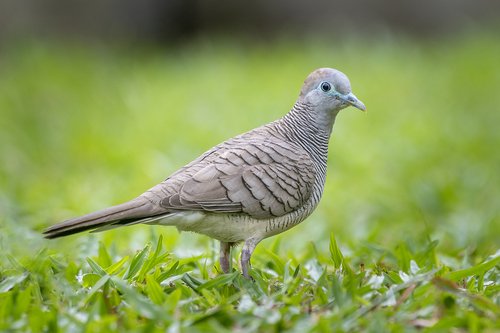
Zebra Dove
Geopelia striata
With their delicate pinstriped feathers and soothing rhythmic calls, Zebra Doves are the peaceful ambassadors of the backyard. These charming ground-dwellers bring a touch of tropical tranquility to any garden path.
Quick Identification
Size
Length: 20-23 cm (8-9 in); Weight: 40-60g (1.4-2.1 oz); Wingspan: 25-30 cm (10-12 in)
Colors
Brownish-grey upperparts, pinkish-buff underparts, with fine black-and-white barring on the neck and sides. Blue-grey skin around the eyes.
Key Features
- Fine black-and-white barring on the neck and flanks
- Long, slender tail with white outer feather tips
- Blue-grey facial skin and beak
- Soft, staccato 'coo-coo-coo' call
When You’ll See Them
Behavior
Zebra Doves are gentle and social ground-dwellers, often seen in pairs or small family groups. They spend the majority of their day foraging on the ground, moving with a distinctive rhythmic bobbing of the head as they walk. They are remarkably well-adapted to human presence, often becoming quite tame in suburban gardens and city parks where they feel safe.
These birds are perhaps best known for their melodic, staccato cooing, which is used to establish territory and attract mates. During courtship, the male performs an elaborate display involving bowing and spreading his tail to showcase the white tips. While they are peaceful by nature, they can be territorial with other doves, using quick wing-flicks to signal dominance during feeding.
EverydayEarth exclusive
Camera Tips
To capture high-quality footage of a Zebra Dove, the most important rule is to get low. These are dedicated ground-feeders, so mounting your camera at human eye level will result in unflattering 'top-down' shots. Instead, place your camera on a small tripod or a weather-proof mount just 3 to 5 inches above the ground. Direct the lens toward a patch of bare soil or short-mown grass where you have previously noticed bird activity. This low-angle perspective provides an intimate view of their intricate barring and soulful facial expressions.
Attracting Zebra Doves to your camera’s field of view is straightforward with a ground-based lure. Scatter a handful of fine birdseed—such as white millet, canary seed, or finely cracked corn—directly on the earth in front of the lens. Avoid large sunflower seeds, as their beaks are too small to crack them comfortably. If you have a water feature, a shallow ground-level birdbath is an irresistible draw. They prefer to drink in open areas where they can keep an eye out for predators, so ensure the 'watering hole' isn't crowded by thick vegetation.
When configuring your AI camera, prioritize a high shutter speed or a 'sports' mode if available. Zebra Doves are 'twitchy' birds with very fast head movements; a standard frame rate can sometimes lead to motion blur. For the best lighting, aim for the 'Golden Hours' just after sunrise or before sunset. The warm, low-angled light emphasizes the subtle pinkish tones of their breast and the iridescent blue of their eye rings, turning a simple backyard clip into a professional-looking wildlife portrait.
During the breeding season, keep an eye out for 'bowing' behavior. If you see two doves interacting, set your camera to record longer clips (30-60 seconds) to capture their rhythmic courtship displays. Because they are creatures of habit, once they find a reliable source of seed in your yard, they will likely return at the exact same time every morning, allowing you to fine-tune your camera placement over several days.
Similar Species
Species that look similar or are commonly confused with Zebra Dove.
Spotted Dove
Much larger than the Zebra Dove, featuring a prominent black-and-white spotted 'collar' on the back of the neck rather than side barring.
Peaceful Dove
A close relative found in Australia; it looks nearly identical but typically has more extensive barring across its breast than the Zebra Dove.
Frequently Asked Questions
Record Zebra Dove at your habitat
Connect a camera to start building your own species record — AI identifies every visitor automatically.