Spotted Dove
Spilopelia chinensis
With its delicate checkered 'pearl neck' and peaceful coo, the Spotted Dove is a charming visitor to any garden. These elegant ground-feeders are remarkably easy to photograph once you know their favorite foraging spots.
Quick Identification
Size
Length: 28–32 cm (11–12.6 in); Wingspan: 43–48 cm (17–19 in); Weight: 110–160 g (3.9–5.6 oz)
Colors
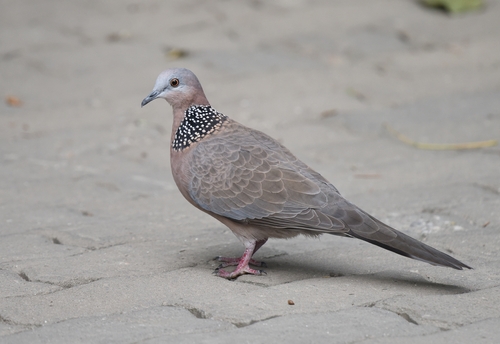
Rosy-grey to buff-colored body with a distinctive black-and-white checkered patch (the 'pearl neck') on the back of the neck. Tail feathers are dark grey with broad white tips on the outer edges. Eyes are orange-red and legs are pinkish-red.
Key Features
- Broad black collar with fine white spots on the back of the neck
- Long, slender tail with conspicuous white outer-feather tips
- Rosy-buff breast fading to grey on the belly
- Rhythmic head-bobbing while walking on the ground
When You’ll See Them
Sightings on EverydayEarth
Jun 30, 2026
A Spotted Dove is seen perched on a metal support bar within the enclosure. It remains relatively stationary throughout the observation, occasionally shifting its weight and looking around the space.
Jun 29, 2026
A Spotted Dove is perched on the wire mesh at the back of the enclosure. It remains mostly still, occasionally turning its head to look around before settling back into a resting position.
Jun 28, 2026
A Spotted Dove is perched on a horizontal metal support bar in the upper portion of the frame. The bird is seen looking around and adjusting its posture while resting in the enclosure at night.
Jun 28, 2026
A Spotted Dove is perched on a wooden crossbeam within the eagle enclosure. It remains largely stationary but stays alert, turning its head several times to observe the surroundings.
Jun 27, 2026
A Spotted Dove is perched on a horizontal beam inside the enclosure. It remains largely stationary, occasionally shifting its weight and turning its head as it rests during the late afternoon.
Jun 26, 2026
A Spotted Dove is perched on a wooden beam inside the enclosure. The bird remains mostly still throughout the footage, occasionally shifting its weight and turning its head to observe its surroundings.
Behavior
The Spotted Dove is a gentle and somewhat shy bird that has become a staple of suburban landscapes. They are primarily ground-dwellers, spending most of their daylight hours walking with a characteristic head-bob as they search for fallen seeds and grains. Unlike many smaller birds that hop, doves walk with a steady, rhythmic gait. When startled, they take off with a loud, clattering wing-beat that serves as a warning to other birds in the vicinity.
These doves are generally seen in pairs or small family groups rather than large flocks. They are famous for their soothing, three-syllable 'coo-coo-coo' call, which the males often perform from a prominent perch like a fence post or telephone wire. During courtship, males perform an impressive aerial display, flying steeply upward with noisy wing-claps before spiraling down with wings and tail spread wide to impress a mate.
EverydayEarth exclusive
Camera Tips
To get the best shots of a Spotted Dove, you need to think low. Because these birds spend almost all their active time on the ground, mounting your AI camera at a height of 6 to 12 inches is ideal. Angle the lens slightly downward toward a flat area of dirt, short grass, or a paved patio. Doves are creatures of habit; if they find a safe spot with food, they will return to the exact same square foot of ground every single day, allowing you to fine-tune your focus for crisp, close-up images.
Attracting them to your camera's field of view is simple: scatter a mix of birdseed, cracked corn, or white millet directly on the ground. They are 'scavenger' feeders and often prefer pecking at the ground beneath a hanging feeder rather than using the feeder itself. If you have a specific rock or garden ornament you'd like them to pose near, place a small handful of seed right in front of it. They also require grit (small pebbles or coarse sand) to help digest their seeds, so a small patch of bare, sandy soil can be a major draw for them.
Water is another powerful lure, especially in drier climates or during hot summer months. Use a shallow, heavy ceramic bird bath or a simple tray on the ground. Doves have a unique way of drinking—they submerge their beaks and suck up water continuously without needing to tilt their heads back. This behavior looks great on video. Place the water source in a spot that receives good morning light to capture the iridescent pinkish-purple sheen on their neck feathers.
For camera settings, use a medium-to-high motion sensitivity. Doves move with a steady, predictable pace, but their head-bobbing can sometimes be missed by low-sensitivity triggers. If your camera allows for 'burst mode' or short video clips, enable it. This is the best way to capture their social interactions, such as the male's elaborate bowing display, where he puffs out his spotted neck feathers and bows deeply to a female while cooing loudly.
Similar Species
Species that look similar or are commonly confused with Spotted Dove.
Mourning Dove
Lacks the black-and-white checkered neck patch and has a more pointed tail.
Laughing Dove
Smaller with a more reddish-brown tone and a speckled gorget on the front of the neck rather than a patch on the back.
Rock Pigeon
Much larger and stockier with variable plumage, typically lacking the slender tail and delicate neck patterning.
Frequently Asked Questions
Record Spotted Dove at your habitat
Connect a camera to start building your own species record — AI identifies every visitor automatically.