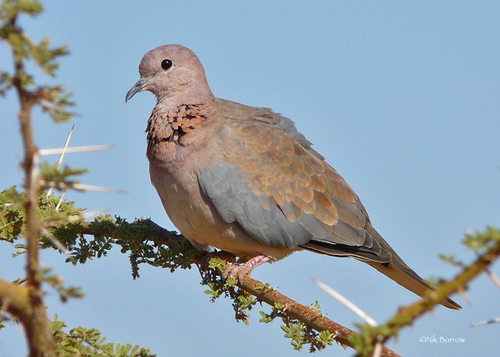
Laughing Dove
Spilopelia senegalensis
A dainty, lilac-toned dove famous for its bubbling, laughter-like call and stippled copper necklace. Found everywhere from the African savanna to the gardens of Perth, it is one of the world's most charming backyard residents.
Quick Identification
Size
Length: 20–24 cm (7.9–9.4 in); Wingspan: 32–36 cm (12.6–14.2 in); Weight: 64–120 g (2.3–4.2 oz)
Colors
Head and neck are pinkish-brown with a lilac wash; wings are blue-grey and earthy brown; breast is pinkish fading to a white belly. Features a distinctive 'necklace' of black stippling on a rufous patch on the throat.
Key Features
- Stippled black-and-copper necklace on the foreneck
- Long, narrow tail with conspicuous white outer feathers
- Small, dainty build with a relatively small head
- Characteristic four or five-syllable 'laughing' coo
When You’ll See Them
Sightings on EverydayEarth
Jun 24, 2026
A Goliath Heron stands prominently on a large rock in the foreground, spendng time preening its feathers. In the river behind it, a hippopotamus rests partially submerged, its ears twitching to clear water. At approximately five seconds into the clip, a Laughing Dove flies into the frame and lands on a rock to the right.
Apr 20, 2026
Two Laughing Doves are perched on a weathered rock beside a body of water. They move across the stone surface with small, jerky steps, occasionally pausing to survey the area in the soft morning light.
Geographic range
Where Does the Laughing Dove Live?
The Laughing Dove is native to the vast landscapes of Sub-Saharan Africa and much of the Middle East, extending through Iran and Afghanistan into the Indian subcontinent. It is a highly successful resident throughout India, Pakistan, and Sri Lanka, where it thrives in both rural and urban settings. Interestingly, a thriving introduced population has been well-established in Western Australia since the late 19th century, centered primarily around the Perth metropolitan area.
Basemap © OpenStreetMap contributors
Behavior
The Laughing Dove is a gentle but remarkably bold species, often found living in close proximity to humans. Unlike more skittish wild pigeons, these doves frequently colonize suburban gardens, town squares, and even busy railway platforms. They are highly terrestrial, spending a significant portion of their day walking along the ground with a bobbing head motion as they search for fallen seeds and small insects.
Socially, they are usually seen in pairs or small family groups, though large numbers may congregate around dependable water sources or grain spills. They are well-known for their unique vocalization—a rising and falling 'coo-coo-roo-do-do' that sounds remarkably like human bubbling laughter. During courtship, males perform a distinctive display flight, rising steeply with loud wing-clapping before gliding down in a graceful arc.
EverydayEarth exclusive
Camera Tips
To capture the best footage of Laughing Doves, positioning is everything. Since they spend the majority of their time foraging on the ground, place your AI-powered camera just 6 to 12 inches off the ground. Aiming the camera at a flat, cleared patch of earth or a low-profile bird bath will yield the clearest results, as these birds prefer stable surfaces where they can walk freely while feeding.
Baiting your camera site with small grains, millet, or crushed corn is highly effective. Unlike larger pigeons, Laughing Doves prefer smaller seeds. If you are using a feeder, ensure it is a ground-tray style or a very low platform. Because they are frequent drinkers, a shallow water dish placed in a sunny spot is often more attractive than food, especially in drier climates or during summer months.
Lighting is crucial for showing off their subtle plumage. Position your camera so the morning sun hits the 'necklace' area, which features beautiful iridescent-like copper and black stippling. Early morning and late afternoon are the 'golden hours' for these birds; they are most active just after sunrise and will often visit the same spot daily at predictable times. If your camera has a 'burst' or 'video' mode, use it to capture their characteristic head-bobbing walk and the unique 'laughing' vocalization that gives them their name.
Similar Species
Species that look similar or are commonly confused with Laughing Dove.
Spotted Dove
Larger with a prominent white-spotted black patch on the back of the neck, rather than the throat.
Eurasian Collared Dove
Paley grey-buff overall with a clean black narrow ring on the back of the neck, lacking the stippled throat pattern.
Namaqua Dove
Much smaller with a very long, pointed tail; males have a striking black face and throat mask.
Frequently Asked Questions
Record Laughing Dove at your habitat
Connect a camera to start building your own species record — AI identifies every visitor automatically.