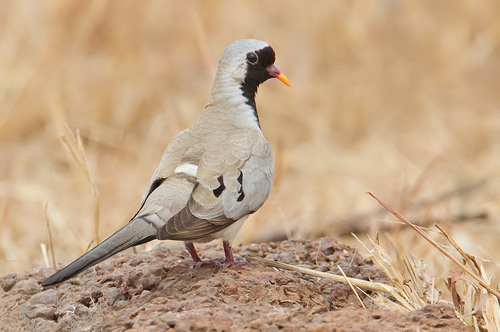
Namaqua Dove
Oena capensis
The Namaqua Dove is a tiny, long-tailed desert gem known for the male's striking black mask and incredible flying speed. Often found in the driest corners of Africa and Arabia, this elegant bird is a master of survival in arid landscapes.
Quick Identification
Size
Length: 22 cm (8.7 in); Wingspan: 28–33 cm (11–13 in); Weight: 28–54 g (1.0–1.9 oz)
Colors
Males have a bold black face, throat, and breast mask; females are plain grey-brown. Both have a yellowish bill and long dark tails.
Key Features
- Extremely long, tapered tail nearly half the total body length
- Bold black face and chest bib on adult males
- Small, sparrow-sized body with slender profile
- Two distinct dark bands across the lower back and rump
When You’ll See Them
Geographic range
Where Does the Namaqua Dove Live?
The Namaqua Dove is native across a vast portion of the African continent, found almost everywhere south of the Sahara Desert. Beyond mainland Africa, its core range extends across the island of Madagascar and much of the Arabian Peninsula, including Saudi Arabia, Yemen, and Oman. While they are highly mobile and nomadic, they are most consistently found in the dry, open savannas of Southern and East Africa, often moving into more urbanized garden environments during periods of drought.
Basemap © OpenStreetMap contributors
Behavior
The Namaqua Dove is a terrestrial specialist, spending most of its time on the ground searching for tiny seeds. Unlike many other pigeons that prefer to perch high in trees, this species is frequently seen walking or running with a characteristic head-bobbing motion. They are incredibly fast fliers, staying low to the ground with rapid, rhythmic wingbeats that produce a faint whistling sound. Despite their delicate appearance, they are hardy survivors of some of the world's harshest arid environments.
Socially, Namaqua Doves are usually found in pairs or small family groups, though they may congregate in larger numbers at waterholes during the dry season. They are somewhat nomadic, moving across vast distances to follow seasonal rains that trigger the growth of the grasses they depend on. In backyard settings, they are often shy but can become habituated to human presence if provided with a quiet, safe space to forage.
EverydayEarth exclusive
Camera Tips
To capture the best footage of the Namaqua Dove, your camera placement should be no more than 6 to 12 inches off the ground. These birds are almost exclusively terrestrial foragers, so a low-angle shot will provide an intimate perspective of their intricate feather patterns and unique masked face. If you have a sandy or gravelly patch in your yard, this is the perfect spot to set up. Use a ground-stake or a flat stone to keep your camera stable at this height.
The absolute best lure for a Namaqua Dove is a shallow water source. In the arid regions they call home, they must drink at least once or twice a day. A ground-level bird bath or a simple dripping water feature will draw them in like a magnet, especially during the heat of the afternoon. If you are using food as a lure, opt for very fine birdseed or crushed millet, as their tiny beaks are not suited for large sunflower seeds or corn. Spread the seed in a small, concentrated area directly in front of the lens.
Because Namaqua Doves have very fast, jerky movements while feeding, use a high frame rate (at least 60fps) if your camera allows it. This will prevent motion blur and allow you to see their rapid pecking behavior clearly. They are most active during the first few hours after sunrise and the golden hour before sunset. Ensure your camera is positioned with the sun at its back to highlight the male's iridescent bill and avoid silhouetting his black mask against a bright background.
Similar Species
Species that look similar or are commonly confused with Namaqua Dove.
Frequently Asked Questions
Record Namaqua Dove at your habitat
Connect a camera to start building your own species record — AI identifies every visitor automatically.