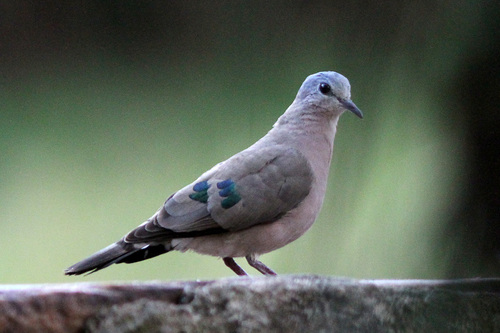
Emerald-spotted Wood-Dove
Turtur chalcospilos
A gem of the African bush, the Emerald-spotted Wood-Dove is famous for its mournful, rhythmic call and the shimmering iridescent patches on its wings. This ground-dwelling beauty is a frequent visitor to quiet gardens across East and Southern Africa.
Quick Identification
Size
20 cm (8 in) in length; wingspan of 35-40 cm (14-16 in); weighs between 50-80 g (1.8-2.8 oz)
Colors
Earth-toned grey-brown upperparts, pinkish-buff underparts, and characteristic iridescent green spots on the wings; black bands on the lower back and tail.
Key Features
- Metallic emerald-green patches on the wing coverts
- Two distinct black bands across the lower back and rump
- Small, compact dove silhouette with a short tail
- Greyish-mauve crown and nape
When You’ll See Them
Geographic range
Where Does the Emerald-spotted Wood-Dove Live?
This wood-dove is native to the African continent, thriving across the vast landscapes of East and Southern Africa. Its core range stretches from Ethiopia and Somalia in the north, southward through Kenya, Tanzania, and Zambia, reaching down to the tip of South Africa. While it is a common sight in these regions, it is notably absent from the dense evergreen rainforests of Central Africa and the extreme arid centers of the Namib and Kalahari deserts.
Basemap © OpenStreetMap contributors
Behavior
The Emerald-spotted Wood-Dove is a shy and largely terrestrial bird, spending much of its day foraging on the ground for seeds and small invertebrates. It moves with a characteristic head-bobbing gait, staying close to the safety of thickets and undergrowth. When disturbed, it tends to fly low and fast into dense cover rather than taking to the open sky, showing off its chestnut-colored underwings in flight.
This species is well-known for its haunting, rhythmic call—a series of deep, mournful 'hoo' notes that accelerate and descend in pitch. Often found in pairs or small family groups, they are generally peaceful birds but can be territorial around preferred feeding patches. In backyard settings, they habituate well to human presence if provided with quiet, bushy corners and consistent water sources.
EverydayEarth exclusive
Camera Tips
To capture the Emerald-spotted Wood-Dove on an AI-powered camera, ground-level placement is essential. These doves are almost exclusively terrestrial foragers, so mounting your camera just 15 to 30 centimeters (6-12 inches) off the ground will provide the best angle. Position the lens to face a patch of bare earth or short grass located near the edge of a hedge or thick shrubbery, as they prefer to feed where they can quickly dive into cover.
Water is a significant attractant for this species, especially in drier climates. Place your camera near a low-profile birdbath or a shallow ground-level water feature. They are cautious drinkers and will often spend several minutes perched nearby before descending to the water, giving your camera plenty of time to trigger. Using a high-sensitivity PIR setting is recommended to ensure the camera picks up their relatively small heat signature.
To get the clearest shots of their namesake emerald spots, try to place your camera in an area with dappled sunlight. Direct, harsh midday sun can wash out the iridescence, while early morning or late afternoon light makes the metallic green patches pop against their muted feathers. If your camera allows for burst mode, use it; these birds move their heads rapidly while foraging, and multiple shots increase your chances of getting a perfectly sharp image. If you want to encourage them to linger, scatter a small amount of fine birdseed or crushed corn thinly across the ground in the camera's field of view.
Similar Species
Species that look similar or are commonly confused with Emerald-spotted Wood-Dove.
Blue-spotted Wood-Dove
Nearly identical in shape, but features iridescent blue wing spots instead of green and prefers wetter, more humid habitats.
Tambourine Dove
The male has a bright white face and breast, and it lacks the distinct double black bands on the lower back found on the Emerald-spotted Wood-Dove.
Namaqua Dove
Much smaller with a significantly longer, pointed tail; males have a striking black face mask and throat.
Frequently Asked Questions
Record Emerald-spotted Wood-Dove at your habitat
Connect a camera to start building your own species record — AI identifies every visitor automatically.