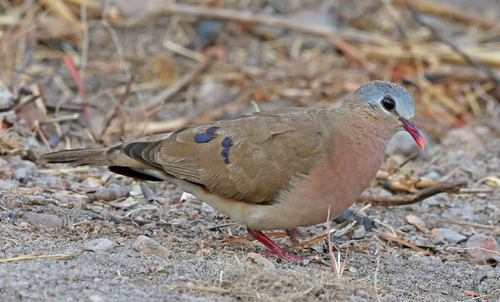
Blue-spotted Wood-Dove
Turtur afer
Admire the sapphire-winged gem of the African forest edge. The Blue-spotted Wood-Dove is a peaceful, ground-dwelling visitor that brings a touch of iridescent beauty and a soulful song to leafy backyards.
Quick Identification
Size
20–22 cm (7.9–8.7 in) in length; weight typically ranges between 50–73 g (1.8–2.6 oz).
Colors
Earth-toned brownish-grey back and wings; vinaceous pinkish-grey breast and underparts; pale grey forehead. Notable for two dark bands on the rump and iridescent blue spots on the wings.
Key Features
- Iridescent sapphire-blue spots on the wings
- Bright red bill with a distinct yellow tip
- Two dark horizontal bands across the lower back and rump
- Grey forehead contrasting with a pinkish-grey face
When You’ll See Them
Geographic range
Where Does the Blue-spotted Wood-Dove Live?
The Blue-spotted Wood-Dove is a quintessential African species, native to the lush, humid regions south of the Sahel. Its range spans broadly across West and Central Africa, from Senegal across to Ethiopia and Kenya in the east. Unlike its cousin the Emerald-spotted Wood-Dove, it avoids the arid regions of Southern Africa, preferring territories with higher rainfall and denser vegetation where it can remain hidden in the shadows.
Basemap © OpenStreetMap contributors
Behavior
The Blue-spotted Wood-Dove is a primarily terrestrial bird, spending the majority of its active hours walking along the ground with a rhythmic, bobbing head motion. While they are often described as shy, they are remarkably persistent foragers that will return to the same spot daily if they find a reliable food source. They are most frequently seen alone or in pairs, rarely forming large flocks unless drawn to a common water source during dry spells.
When disturbed, this dove performs a fast, low-level flight, often making a distinct 'clapping' sound with its wings as it takes off. They are highly vocal, especially during the early morning. Their call is a mournful, repetitive series of hooting notes—'du-du-du-du-du'—which starts slowly, accelerates in the middle, and then gradually fades away. This sound is a quintessential part of the morning chorus in many African forest edges and gardens.
EverydayEarth exclusive
Camera Tips
To capture the Blue-spotted Wood-Dove on camera, you must focus on the ground. These birds are 'understory specialists' and rarely visit elevated feeders. Place your AI-powered camera 12 to 15 inches from the ground, mounted on a low stake or the base of a tree. Angle the lens slightly downward to cover a patch of bare earth or short grass. Because they are cautious, position the camera near the edge of dense shrubbery or a hedge, which provides them with a sense of security and a quick escape route.
The absolute best lure for this species is water. A shallow, ground-level birdbath or a simple terracotta saucer filled with fresh water will attract them more consistently than food, especially in the late afternoon. If you prefer to use bait, scatter a mix of small seeds like millet, niger seed, or finely cracked corn directly on the ground. Avoid using large sunflower seeds or whole peanuts, as their small bills are better suited for tiny grains.
Set your camera to a high-sensitivity PIR setting. Wood-doves move with a characteristic 'stop-and-start' motion that can sometimes be missed by slower sensors. Because they forage in the shade of trees, the lighting can be tricky; if your camera allows for exposure adjustment, a slight increase can help reveal the iridescent blue spots on their wings which might otherwise look like dark patches in the shade. High-definition video clips of 10-15 seconds are ideal for capturing their unique head-bobbing walk and melodic calls.
Similar Species
Species that look similar or are commonly confused with Blue-spotted Wood-Dove.
Frequently Asked Questions
Record Blue-spotted Wood-Dove at your habitat
Connect a camera to start building your own species record — AI identifies every visitor automatically.