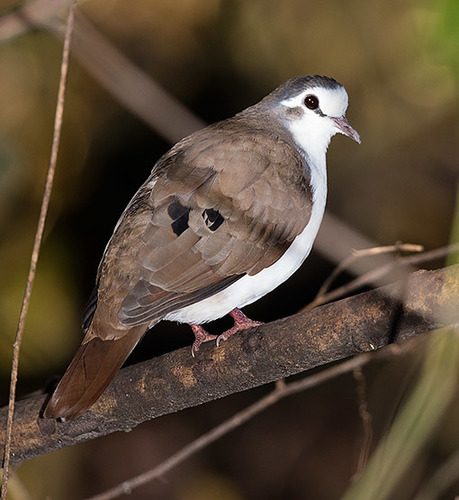
Tambourine Dove
Turtur tympanistria
A secretive gem of the African woodlands, the Tambourine Dove is a master of the forest floor. With its striking white plumage and rhythmic call, it brings a touch of wild mystery to any quiet, wooded garden.
Quick Identification
Size
Length: 20-22 cm (7.9-8.7 in); Weight: 50-80 g (1.8-2.8 oz)
Colors
Males have a brilliant white face and underparts with dark brown upperparts; females are duller with grey-white underparts and a grey face. Both have metallic green or purple wing spots.
Key Features
- Stark white face and chest (males)
- Metallic green or purple iridescent wing patches
- Fast, low-darting flight through thickets
- Small, compact body with a relatively short tail
When You’ll See Them
Behavior
The Tambourine Dove is a shy and largely terrestrial species that prefers the quiet sanctuary of the forest floor. Unlike many other pigeons that congregate in large, noisy flocks, this dove is typically found alone or in pairs. It spends much of its day quietly walking through leaf litter, searching for fallen seeds and small fruits. Because of its cautious nature, it is more often heard than seen, frequently emitting a distinctive call that starts with slow 'du-du' notes and accelerates into a rapid, vibrating roll that mimics the sound of a tambourine.
When startled, the Tambourine Dove performs a rapid, low-level flight, expertly navigating through dense vegetation with impressive agility. While they are wary of human presence, they can become quite regular visitors to quiet, well-wooded suburban gardens, especially those that offer plenty of ground-level cover and a reliable source of water. Their social interactions are usually limited to their mate, with whom they share nesting duties in a flimsy platform of twigs hidden deep within a bush or tree.
EverydayEarth exclusive
Camera Tips
To successfully capture a Tambourine Dove on camera, you must think like a ground-dweller. Position your AI-powered camera low to the ground—ideally between 10 and 15 inches high. These doves are most comfortable foraging in the 'edge zone' where thick vegetation meets a small clearing. Aim your camera at a patch of bare earth or leaf litter directly adjacent to a dense hedge or shrubbery, as they rarely venture far from a quick escape route.
Water is your best tool for attracting this species. A ground-level birdbath or a shallow, circulating water feature in a shaded corner of the yard is a high-traffic area for Tambourine Doves. They are particularly active during the drier months when natural puddles disappear. Set your camera to 'Video Mode' or 'Burst Photo' with a high trigger speed; these birds are twitchy and can vanish in a heartbeat if they sense movement or a predator.
If you are using bait, avoid elevated feeders. Instead, scatter small seeds like millet, crushed maize, or fine birdseed mixes directly on the ground. Because these doves are most active during the soft light of dawn and dusk, ensure your camera has good low-light performance or 'Golden Hour' settings. Avoid placing the camera in direct, harsh sunlight, as the high contrast can wash out the male's brilliant white chest, making identification harder for AI sensors.
Lastly, be patient and minimize human activity near the camera site. Tambourine Doves are sensitive to changes in their environment. Once they feel safe and recognize your garden as a reliable, quiet food or water source, they will return at almost the exact same time every day, allowing you to fine-tune your camera angle for that perfect close-up shot.
Similar Species
Species that look similar or are commonly confused with Tambourine Dove.
Emerald-spotted Wood Dove
Lacks the pure white face and breast of the male Tambourine Dove and has two dark bands across the lower back.
Blue-spotted Wood Dove
Features blue wing spots instead of green/purple and has a more uniform grey-brown coloration without the stark white underparts.
Lemon Dove
Slightly larger with a more cinnamon or 'lemon' colored underbelly and lacks the metallic wing spots.
Frequently Asked Questions
Record Tambourine Dove at your habitat
Connect a camera to start building your own species record — AI identifies every visitor automatically.