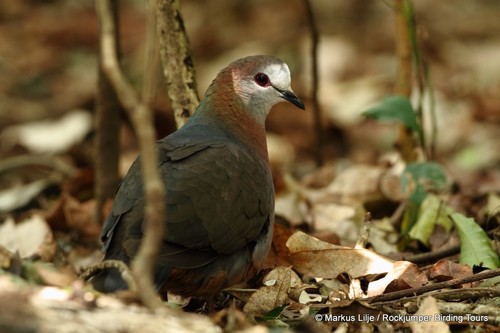
Lemon Dove
Aplopelia larvata
A secretive gem of the African forest, the Lemon Dove enchants with its warm cinnamon breast and ghostly white face. Often heard before it is seen, this ground-dwelling beauty is a master of camouflage in the shadows of the undergrowth.
Quick Identification
Size
24-30 cm (9.5-12 in) in length; weighs approximately 130-150 g (4.6-5.3 oz)
Colors
Brownish-grey upperparts, rich cinnamon-brown breast and belly, white forehead and face, with iridescent green or pinkish-purple patches on the neck.
Key Features
- Cinnamon-colored underparts
- White forehead and facial markings
- Dark brownish-grey wings and back
- Subtle iridescent green gloss on the nape
- Terrestrial, ground-hugging posture
When You’ll See Them
Geographic range
Where Does the Lemon Dove Live?
Native to the African continent, the Lemon Dove thrives in the high-altitude, montane forests of Sub-Saharan Africa. Its range is somewhat fragmented, stretching from the highlands of Ethiopia down through the Great Lakes region into the eastern and southern parts of South Africa. While it is a resident species throughout its range, it is most frequently encountered in the mist-belt forests and temperate woodlands of Kenya, Tanzania, and the KwaZulu-Natal province of South Africa.
Basemap © OpenStreetMap contributors
Behavior
The Lemon Dove is a notoriously shy and secretive resident of the forest floor. Unlike many of its pigeon cousins that congregate in large, noisy flocks, this species is typically solitary or found in quiet pairs. They spend the vast majority of their time walking slowly through deep shade, tilting their heads as they search for food among the leaf litter. Because of their preference for dense undergrowth, they are more often heard—emitting a low, mournful 'cooo'—than they are seen.
When disturbed, the Lemon Dove rarely takes to the high canopy. Instead, it will either freeze in place, relying on its cinnamon and grey plumage to blend into the shadows, or it will fly off with a sudden, loud clap of wings to a low branch nearby. They are not particularly aggressive toward humans but will quickly abandon a foraging spot if they feel watched or exposed, making them a challenging but rewarding subject for backyard observation.
EverydayEarth exclusive
Camera Tips
To capture the Lemon Dove on camera, you must focus your efforts on the ground. This species rarely visits hanging feeders, preferring to glean food from the floor. Place your camera at a very low height—no more than 15 to 20 centimeters (6-8 inches) off the ground—and angle it slightly upward. This mimics the bird's eye level and captures the striking white of the forehead and the iridescence of the neck feathers which are often lost in high-angle shots.
Since Lemon Doves prefer deep shade, lighting is your biggest challenge. Positioning your camera in a location that receives dappled morning light can help highlight the cinnamon tones of their breast without overexposing the white facial markings. If you are using a trail camera, ensure it has a high-quality low-light sensor or 'no-glow' infrared, as these birds are easily spooked by the visible red glow of some flash systems.
You can encourage them to visit a specific spot by creating a 'micro-habitat' of leaf litter mixed with cracked corn or small wild bird seeds. Clear a small 1-meter square patch of ground in a quiet, shaded corner of your garden and keep it consistently stocked. Because they are shy, avoid placing the camera in high-traffic areas; the back edge of a garden near dense shrubs is ideal.
Set your camera to take short video bursts (10-15 seconds) rather than just stills. The Lemon Dove has a very distinctive, rhythmic walking motion and a subtle head-bob that is much more interesting to watch in motion. Ensure the trigger speed is fast, as they can move surprisingly quickly when they decide to retreat back into the shadows.
Similar Species
Species that look similar or are commonly confused with Lemon Dove.
Frequently Asked Questions
Record Lemon Dove at your habitat
Connect a camera to start building your own species record — AI identifies every visitor automatically.