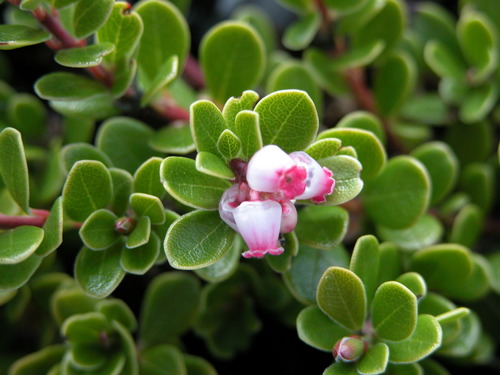
bearberry
Arctostaphylos uva-ursi
A resilient evergreen groundcover that paints northern landscapes with waxy pink blooms and brilliant red berries. Known as Kinnikinnick, this hardy shrub is a favorite of both pollinators and foraging wildlife.
Quick Identification
Size
Grows 5-30 cm (2-12 inches) in height with trailing woody stems that spread up to 4.5 meters (15 feet) wide.
Colors
Dark glossy green leaves; urceolate (bell-shaped) flowers in white to pale pink; bright scarlet or deep red berries.
Key Features
- Low-growing, mat-forming evergreen habit
- Thick, leathery oval leaves that turn reddish in winter
- Small clusters of drooping, waxy bell-shaped flowers
- Vibrant red fruit that persists into the winter
When You’ll See Them
Geographic range
Where Does the bearberry Live?
Bearberry is a truly circumboreal species, claiming a massive footprint across the northern reaches of the Northern Hemisphere. It is natively found throughout the subarctic regions of North America, Europe, and Asia, stretching from the rugged coasts of Scandinavia and Siberia to the windswept tundras of Alaska and Canada. In the lower United States, its range dips southward along the mountain spines of the Rockies and Appalachians, as well as along the sandy shores of the Great Lakes.
Basemap © OpenStreetMap contributors
Behavior
Bearberry is a slow-growing, long-lived woody groundcover that functions as a cornerstone species in sandy or rocky ecosystems. Unlike many plants that struggle in nutrient-poor soil, bearberry thrives by forming symbiotic relationships with mycorrhizal fungi, which help it extract minerals from harsh environments. It spreads slowly through its trailing stems, which root at intervals to create a dense, erosion-resistant carpet.
Ecologically, the plant is a vital resource for early-season pollinators, particularly bumblebees, who are attracted to the nectar-rich blooms in late spring. As the seasons turn, the plant produces 'drupes' (the red berries) that serve as an essential food source for various birds and mammals. While the berries are famously mealy and tasteless to humans, they provide high-energy forage for wildlife throughout the leaner months of autumn and winter.
EverydayEarth exclusive
Camera Tips
To successfully capture bearberry on a trail camera, you must think like a macro photographer. Because this plant rarely exceeds a few inches in height, your camera should be mounted as close to the ground as possible. Use a ground spike or a small beanbag to stabilize the camera, angling the lens slightly downward to capture the texture of the leaves and the clusters of fruit. If your camera has a 'close-up' or 'macro' focus setting, ensure it is enabled to prevent the foreground from blurring.
The real magic happens when you use bearberry as a natural stage for wildlife. Position your camera near a large, healthy mat of the plant during the fruiting season (late summer to early winter). Small mammals like chipmunks and squirrels, as well as birds such as ruffed grouse and thrushes, frequently visit the plant to harvest the berries. Set your trigger speed to the fastest possible setting to catch these quick-moving visitors as they forage among the leaves.
Lighting is your biggest challenge and your best friend. Bearberry thrives in open sunlight, which can cause harsh highlights and deep shadows that obscure the plant's details. To get the best results, set your camera to take time-lapse photos during the 'golden hours' of dawn and dusk. The low-angle light will emphasize the waxy sheen of the evergreen leaves and make the bright red berries pop against the green background. In winter, bearberry is a fantastic subject for capturing contrast against the snow, so keep your cameras out even when the temperature drops.
Similar Species
Species that look similar or are commonly confused with bearberry.
Frequently Asked Questions
Record bearberry at your habitat
Connect a camera to start building your own species record — AI identifies every visitor automatically.