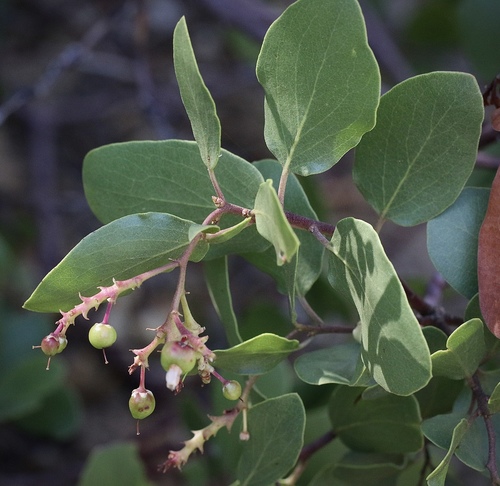
greenleaf manzanita
Arctostaphylos patula
With its striking mahogany bark and vibrant green foliage, the greenleaf manzanita is more than just a mountain shrub—it's a bustling hub for Western wildlife.
Quick Identification
Size
Height: 1-2 meters (3-6.5 feet); Spread: 2-4 meters (6.5-13 feet)
Colors
Bright apple-green leaves, smooth mahogany-red to chocolate-brown bark, and clusters of pale pink to white bell-shaped flowers.
Key Features
- Smooth, reddish-brown peeling bark
- Bright green, leathery oval leaves held vertically
- Small, urn-shaped pinkish flowers in hanging clusters
When You’ll See Them
Geographic range
Where Does the greenleaf manzanita Live?
The greenleaf manzanita is a hallmark of the mountainous regions of western North America. Its native range extends from British Columbia in Canada, south through the Cascades and Sierra Nevada of Washington, Oregon, and California, and reaches eastward into the high-elevation zones of Nevada, Utah, and Colorado. These shrubs are most commonly found in the transition zones between lower-elevation sagebrush and higher-elevation pine forests, thriving in sun-drenched, well-drained clearings.
Basemap © OpenStreetMap contributors
Behavior
The greenleaf manzanita is a hardy, fire-adapted shrub that plays a central role in its ecosystem. Unlike many other manzanitas, it possesses a lignotuber—a woody swelling at the base—which allows it to sprout vigorously after a wildfire. It is a slow-growing but long-lived species, often forming dense, twisted thickets that provide essential cover for small mammals and nesting birds.
Ecologically, it acts as a primary food source for a variety of species. In early spring, its nectar-rich flowers provide one of the first meals for emerging bumblebees and migrating hummingbirds. By late summer, the plant produces 'little apples' (the literal translation of manzanita), which are high-energy fruits sought after by bears, coyotes, and various songbirds who depend on them for winter fat stores.
EverydayEarth exclusive
Camera Tips
Capturing wildlife around a greenleaf manzanita requires a 'station' approach. Because this shrub is a major food source, it serves as a natural lure for many animals. Position your camera about 2 to 3 feet off the ground, angled slightly downward toward a cluster of ripening berries or a well-traveled opening in a manzanita thicket. If you are targeting pollinators or hummingbirds, use a high-speed trigger or video mode focused specifically on the flower clusters during the spring bloom.
For larger mammals like black bears or coyotes who love the fruit, place the camera on a nearby tree trunk about 10-15 feet away from the shrub to get a wide field of view. The dark, reddish bark of the manzanita provides excellent contrast, making it a beautiful backdrop for nighttime infrared shots. Ensure your PIR (Passive Infrared) sensor sensitivity is set to medium-high to catch smaller birds like Fox Sparrows or Spotted Towhees that often forage in the leaf-litter beneath the branches.
Timing is everything with this species. In the spring (April to June), focus on the flowers to catch bees and hummingbirds. In the late summer and fall, focus on the berries. Since manzanitas are evergreen, they provide great structural interest for your camera setup even in winter, when you might capture mule deer or rabbits using the dense branches for shelter from the snow. Always ensure the camera lens is clear of any thin, swaying manzanita twigs, as their rigidity can cause false triggers during windy mountain afternoons.
Similar Species
Species that look similar or are commonly confused with greenleaf manzanita.
Frequently Asked Questions
Record greenleaf manzanita at your habitat
Connect a camera to start building your own species record — AI identifies every visitor automatically.