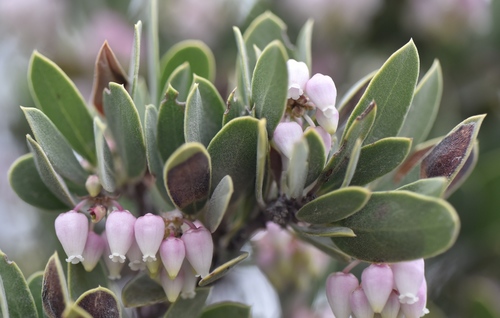
pointleaf manzanita
Arctostaphylos pungens
The pointleaf manzanita is a sculptural masterpiece of the high desert, recognizable by its twisting mahogany branches and delicate, bell-shaped blooms. This hardy evergreen serves as a vital 'supermarket' for Southwestern wildlife, offering nectar in the winter and fruit in the summer.
Quick Identification
Size
Height of 1–3 m (3–10 ft) with a similar or wider spread
Colors
Smooth mahogany-red or deep chocolate bark; bright green to olive evergreen leaves; white to pale pink flowers
Key Features
- Smooth, reddish-brown bark that peels in thin flakes
- Pointed, leathery evergreen leaves
- Clusters of drooping, urn-shaped flowers
- Dull red, apple-like berries (drupes)
When You’ll See Them
Geographic range
Where Does the pointleaf manzanita Live?
Pointleaf manzanita is native to the North American continent, flourishing across the rugged landscapes of the Southwestern United States and northern to central Mexico. Its core range includes the arid mountains of Arizona, New Mexico, and Texas, extending northward into the rocky high deserts of Utah and Nevada. In Mexico, it is a dominant feature of the high-altitude chaparral and woodland zones within the Sierra Madre Occidental and Oriental ranges.
Basemap © OpenStreetMap contributors
Behavior
Pointleaf manzanita is a slow-growing, long-lived evergreen shrub that plays a structural role in its ecosystem. Unlike animals, its 'behavior' is defined by its seasonal cycles and resilience. It is highly adapted to fire-prone environments; while the adult plant is often killed by intense flames, its seeds possess a thick coating that requires the heat of a fire or the digestive acids of an animal to germinate. This ensures that the manzanita is among the first species to reclaim the landscape after a wildfire.
Ecologically, this shrub acts as a focal point for local wildlife. Its dense, stiff branching structure provides a fortress-like cover for small mammals and ground-nesting birds, protecting them from aerial predators. In the late winter when few other plants are active, its early-blooming flowers provide a critical nectar source for overwintering pollinators and early-season hummingbirds.
EverydayEarth exclusive
Camera Tips
To capture wildlife visiting a pointleaf manzanita, focus your camera on the 'resource zones' of the plant. During late winter and early spring, aim your lens at the clusters of white, urn-shaped flowers. This is the best time to capture high-speed footage of hummingbirds and various native bees. Because these shrubs are often dense, look for a natural opening in the foliage where an animal might enter or exit to reach the inner branches.
When the fruit ripens into dull red berries in the summer, move your camera to a lower position, about 18 to 24 inches off the ground, facing the base of the shrub. This is prime time for capturing 'berry-munching' behavior from black bears, gray foxes, and coyotes. If your camera has a macro or close-focus setting, use it to capture the unique, peeling texture of the mahogany bark, which provides a beautiful, high-contrast background for any wildlife that scurries across it.
Be mindful of the wind; manzanita branches are stiff and can cause constant false triggers if they are moving in the foreground of your motion sensor. Choose a camera location on the leeward side of the bush or prune back a few small twigs to clear the sensor's field of view. Because this plant thrives in bright, high-contrast desert light, adjust your camera's exposure settings slightly downward to prevent the bright green leaves from looking 'blown out' in midday sun recordings.
Similar Species
Species that look similar or are commonly confused with pointleaf manzanita.
Frequently Asked Questions
Record pointleaf manzanita at your habitat
Connect a camera to start building your own species record — AI identifies every visitor automatically.