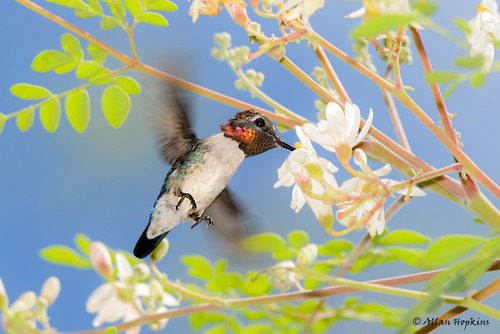
Bee Hummingbird
Mellisuga helenae
Meet the smallest bird on the planet—a feathered jewel no larger than a thumb. Endemic to Cuba, the Bee Hummingbird is a master of high-speed flight and iridescent beauty.
Quick Identification
Size
Length: 5–6 cm (2.0–2.4 in); Wingspan: ~3 cm (1.2 in); Weight: 1.6–2.6 g (0.05–0.09 oz)
Colors
Males feature an iridescent pileus (cap) and gorget (throat) in fiery pinkish-red with elongated lateral plumes; females are bluish-green above and pale gray below.
Key Features
- World's smallest bird, roughly the size of a large bumblebee
- Males have iridescent reddish-pink head plumage during breeding season
- Incredibly rapid wingbeats create a distinct humming sound
- Slender, straight bill adapted for nectar extraction
When You’ll See Them
Geographic range
Where Does the Bee Hummingbird Live?
Native to the Caribbean, the Bee Hummingbird is found exclusively on the island of Cuba. While it was once common throughout the archipelago, its current range is fragmented, with core populations concentrated in the Zapata Swamp, the Guanahacabibes Peninsula, and parts of eastern Cuba. It is a true island specialist, perfectly adapted to the tropical ecosystems of the Cuban mainland and the Isla de la Juventud.
Basemap © OpenStreetMap contributors
Behavior
The Bee Hummingbird is an extraordinary aerial specialist, capable of hovering with incredible precision and even flying backwards or upside down. Due to their exceptionally high metabolic rate, they spend the vast majority of their day feeding, visiting up to 1,500 flowers in a single session. They are most famous for their wing speed, which can reach up to 80 beats per second during normal flight and up to 200 beats per second during courtship displays.
These tiny birds are generally solitary and can be surprisingly territorial over high-quality nectar sources. During the breeding season, males perform spectacular U-shaped diving displays to attract females, shimmering in the sunlight to show off their iridescent throat feathers. Despite their size, they are bold and active, though they are often overlooked by casual observers who mistake them for large insects.
EverydayEarth exclusive
Camera Tips
Capturing the Bee Hummingbird requires specialized attention to speed and scale. Because they are the size of a large bee, standard wide-angle backyard cameras will likely miss them or record them as a blurry speck. Use a camera with a high-speed trigger and place it within 2 to 4 feet of nectar-rich flowers. To freeze their rapid wing motion, you will need a manual shutter speed of at least 1/2000s, though 1/4000s is ideal if lighting allows.
Position your camera to take advantage of direct sunlight, which is necessary to reveal the male's spectacular iridescent pink-red gorget. Without proper lighting, these vibrant colors will appear as dull black or dark brown. Aim the camera at eye level with flowering shrubs like Hamelia patens (Firebush) or Solandra. If your camera has a 'Zone' focus or Macro mode, use it to ensure the bird remains sharp even when it moves slightly toward or away from the lens.
Since these birds are tiny, use a high-sensitivity motion trigger or an AI-powered detection system specifically calibrated for birds. In backyard settings within their range, maintaining a consistent water mister can be a great lure; Bee Hummingbirds love to fly through fine mist to clean their feathers. Ensure your camera is mounted securely, as even a slight vibration can ruin the composition of such a small subject.
Similar Species
Species that look similar or are commonly confused with Bee Hummingbird.
Frequently Asked Questions
Record Bee Hummingbird at your habitat
Connect a camera to start building your own species record — AI identifies every visitor automatically.