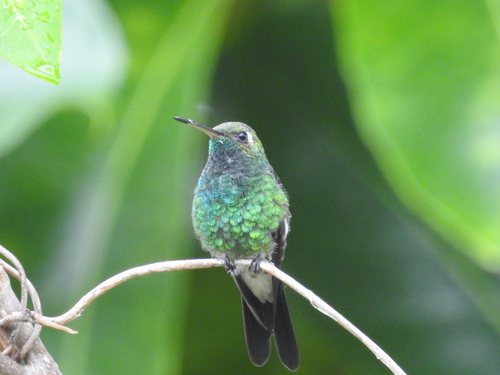
Cuban Emerald
Riccordia ricordii
The Cuban Emerald is a shimmering jewel of the Caribbean, known for its bold personality and striking iridescent green plumage. A frequent visitor to island gardens, this resilient hummingbird brings a spark of high-speed energy to any backyard.
Quick Identification
Size
Length 10.5–11.5 cm (4.1–4.5 in); wingspan approx. 13 cm (5.1 in); weight 3.5–5 g (0.12–0.18 oz)
Colors
Iridescent emerald green overall; males have a deeply forked blackish tail; females have greyish-white underparts and a less forked tail; both sexes feature a distinct white spot behind the eye.
Key Features
- Shimmering metallic green plumage
- Deeply forked dark tail (prominent in males)
- Small white patch directly behind the eye
- Slightly decurved black bill
When You’ll See Them
Geographic range
Where Does the Cuban Emerald Live?
This vibrant hummingbird is a native gem of the Caribbean, found naturally across the entire archipelago of the Bahamas and throughout the island of Cuba, including the Isle of Youth. It thrives in a variety of island ecosystems, ranging from coastal thickets to lush, high-altitude gardens. While it is a permanent resident in its island home, adventurous individuals are occasionally spotted as vagrants in South Florida, though it has not established a breeding population on the North American mainland.
Basemap © OpenStreetMap contributors
Behavior
The Cuban Emerald is a bold and highly territorial hummingbird known for its energetic presence in Caribbean gardens. It is a fierce defender of its nectar sources, often seen chasing away larger birds or competing hummingbirds with rapid, aggressive flight patterns. Despite their small size, they are incredibly hardy and are one of the most visible bird species within their range, often hovering just inches away from humans who provide feeders.
These birds are most vocal during the breeding season, emitting a series of high-pitched, metallic 'tinkling' or 'chirping' notes. Their flight is characterized by extremely rapid wingbeats that create a low humming sound, and they are capable of hovering perfectly still while feeding. In addition to nectar, they are frequently observed performing 'hawking' maneuvers, where they dart into the air to catch tiny flying insects.
EverydayEarth exclusive
Camera Tips
To capture the stunning iridescence of the Cuban Emerald, placement is everything. Position your AI-powered camera within 2 to 3 feet of a nectar feeder or a cluster of native tubular flowers like Firebush (Hamelia patens) or Coral Honeysuckle. Because these birds move at incredible speeds, set your camera to its highest possible frame rate or use a 'burst' mode to ensure you don't just get a green blur. Angle the camera so the sun is behind or to the side of the lens; this lighting is crucial for catching the metallic sheen of their feathers rather than having them appear as a dark silhouette.
Height is also a key factor; aim for a mounting height of 4 to 5 feet off the ground, which aligns with their preferred foraging level. If you are using a feeder, try to find a camera mount that attaches directly to the feeder or a nearby shepherd’s hook. This close-up perspective allows the AI to trigger more reliably and provides the high-detail shots of the white eye-spot and forked tail that make for great profile photos. Avoid placing the camera in high-wind areas, as swaying flowers or feeders can cause false triggers.
Since they are most active in the early morning and late afternoon, ensure your camera's exposure settings are optimized for these 'golden hours' to get the best color saturation. During the hotter parts of the day, they may visit less frequently, but they often seek shade nearby. If you have a birdbath with a mister or a very shallow dripping feature, placing a camera there can yield unique shots of them bathing. This behavior is much rarer to capture than feeding and provides a fascinating look at their grooming habits.
Similar Species
Species that look similar or are commonly confused with Cuban Emerald.
Bahama Woodstar
The Woodstar has a shorter, more rounded tail and lacks the distinct white spot behind the eye found on the Cuban Emerald.
Bee Hummingbird
The Bee Hummingbird is significantly smaller (the world's smallest bird) and males have a bright red-pink hood, whereas the Cuban Emerald is larger and almost entirely green.
Frequently Asked Questions
Record Cuban Emerald at your habitat
Connect a camera to start building your own species record — AI identifies every visitor automatically.