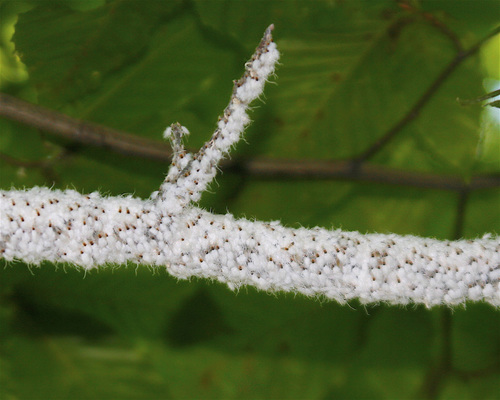
Beech Blight Aphid
Grylloprociphilus imbricator
Nicknamed the 'boogie-woogie aphid' for its synchronized dancing, this tiny insect turns American Beech branches into a pulsing sea of white fluff. While they look like a fungus, these social insects are a fascinating example of defensive behavior in the backyard wilderness.
Quick Identification
Size
Individual aphids are 2-4 mm (0.08-0.15 inches) long, though they form massive colonies that can coat entire branches.
Colors
Bright white or bluish-white due to long, waxy filaments; the underlying body is a dark brownish-purple.
Key Features
- Covered in long, white, wool-like waxy filaments
- Synchronized rhythmic swaying or 'dancing' when disturbed
- Forms dense, snow-like clusters on beech branches
- Associated with thick, black sooty mold on the ground below
When You’ll See Them
Geographic range
Where Does the Beech Blight Aphid Live?
Native to the eastern half of North America, the Beech Blight Aphid is found wherever its primary host, the American Beech, thrives. Its range extends from the maritime provinces of southeastern Canada down through the eastern United States to Florida, and west toward the Mississippi River basin. Because they rely so heavily on specific host trees, their presence is patchy but common within these forested regions.
Basemap © OpenStreetMap contributors
Behavior
The Beech Blight Aphid is most famous for its unique defensive display, earning it the nickname 'boogie-woogie aphid.' When a colony is disturbed by a predator or a passing human, the nymphs lift their posterior ends and sway rhythmically in unison. This mass of pulsing white fluff is thought to confuse predators like birds or lacewing larvae, making it difficult for them to target a single insect.
Unlike most aphids, which are passive, Beech Blight Aphids can be surprisingly aggressive. The nymphs are known to use their piercing mouthparts to poke or 'bite' potential threats, including human skin, which can cause a mild, itchy irritation. They live in highly socialized clusters, feeding on the sap of their host trees and excreting a sugary substance known as honeydew.
This honeydew production is so prolific that it often leads to the growth of a specific fungus, *Scorias spongiosa*, or beech boogie-woogie sooty mold. This fungus grows into a large, black, sponge-like mass on the branches and ground beneath the aphid colony. While the aphids themselves disappear in winter, the black mold remains as a tell-tale sign of their presence during the previous summer.
EverydayEarth exclusive
Camera Tips
To capture the Beech Blight Aphid, you'll need to focus on macro photography or high-resolution close-ups. Standard trail cameras are often set too far away to resolve individual insects, so mounting your camera within 12-24 inches of a colonized branch is essential. Look for 'snow' on the branches of American Beech trees starting in mid-summer; once you find a colony, you have a stationary subject that will remain in place for weeks.
The real magic of this species is their movement, so switch your camera to video mode. To trigger their famous 'boogie-woogie' dance, a slight vibration of the branch or even a gentle puff of air near the camera's sensor can set the whole colony in motion. High-frame-rate settings will allow you to slow down the footage in post-production, revealing the intricate, synchronized swaying of their waxy tails.
Lighting is your biggest challenge and your best friend. The white waxy filaments are highly reflective and easily 'blown out' in direct sunlight. For the best results, position your camera to take advantage of dappled shade or backlighting. Backlighting the colony against a dark forest background makes the white filaments glow, creating a stunning halo effect that emphasizes their woolly texture.
Finally, don't just look up. If you are struggling to find the aphids, look at the forest floor for 'sooty mold'—large, black, spongy growths on the ground or lower trunk. These are fed by the aphid's honeydew and act as a biological neon sign pointing you directly to the colony overhead. Set your camera at a slight upward angle to capture both the colony and the dripping honeydew that fuels the ecosystem below.
Similar Species
Species that look similar or are commonly confused with Beech Blight Aphid.
Frequently Asked Questions
Record Beech Blight Aphid at your habitat
Connect a camera to start building your own species record — AI identifies every visitor automatically.