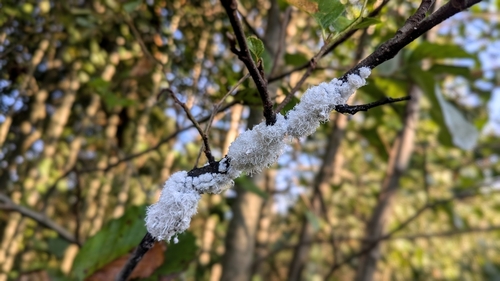
Woolly Alder Aphid
Prociphilus tessellatus
Often mistaken for a fungus or a dusting of snow, the Woolly Alder Aphid is one of the most charismatic insects in the backyard. These 'boogie-woogie' bugs create a spectacular shimmering display when they feel threatened, turning a simple tree branch into a pulsing sea of white fluff.
Quick Identification
Size
Individual aphids are 2–3 mm (0.08–0.12 inches), but colonies can cover several inches of a branch.
Colors
Blue-black or gray bodies hidden beneath long, white, trailing waxy filaments that resemble cotton or wool.
Key Features
- Thick covering of white, waxy 'wool' filaments
- Found in dense clusters on alder twigs or silver maple leaves
- Distinctive 'pulsing' or 'dancing' motion when disturbed
- Two-host lifecycle alternating between maple and alder
When You’ll See Them
Behavior
The Woolly Alder Aphid is best known for its 'boogie-woogie' behavior. When a predator or a large object (like a curious human) approaches the colony, the aphids lift their abdomens and pulse in unison, creating a shimmering white wave. This collective movement is thought to confuse predators like birds or lacewings. Despite their common name, they lead a complex double life, migrating between Silver Maples in the spring and Alders in the summer and fall.
These aphids are prolific 'honeydew' producers. As they suck sap from their host plants, they excrete a sugary liquid that coats the branches below. This often leads to the growth of black sooty mold, which, while unsightly, is part of the natural ecosystem. You’ll often see ants 'herding' these aphids, protecting them from predators in exchange for a taste of that sweet honeydew. Interestingly, they are the primary food source for the Harvester butterfly caterpillar, the only carnivorous butterfly larva in North America.
EverydayEarth exclusive
Camera Tips
Capturing the Woolly Alder Aphid requires a shift in perspective compared to larger wildlife. Because these insects are tiny, your AI-powered camera or trail cam needs to be positioned for macro or extreme close-up shots. Look for 'snowy' patches on the underside of Silver Maple leaves in late spring or on the gray branches of Alders near water sources in the summer. Mount your camera just 6 to 12 inches away from the infested branch to capture the intricate details of their waxy filaments.
To trigger the most interesting footage—the famous 'dancing' behavior—you don't necessarily need a lure, but a slight physical vibration or a shadow passing over the colony often sets them off. If your camera has a high-speed video mode or time-lapse capability, use it. Time-lapse is particularly effective for showing how the colony expands across a branch over several days, while high-speed video is the only way to truly appreciate the rhythmic pulsing of the colony's defensive dance.
Lighting is your biggest challenge and best friend with this species. Their white waxy coating is highly reflective, which can 'blow out' your image in direct sunlight. Aim for a position where the branch is in dappled shade or use a diffuser to soften the light. Early morning or late afternoon provides the best 'rim lighting' that makes the woolly filaments glow against the dark bark of the alder. If you are using a trigger-based camera, ensure the sensitivity is high, as the motion of the aphids themselves is subtle, though the collective 'dance' is usually enough to wake a sensitive sensor.
Similar Species
Species that look similar or are commonly confused with Woolly Alder Aphid.
Frequently Asked Questions
Record Woolly Alder Aphid at your habitat
Connect a camera to start building your own species record — AI identifies every visitor automatically.