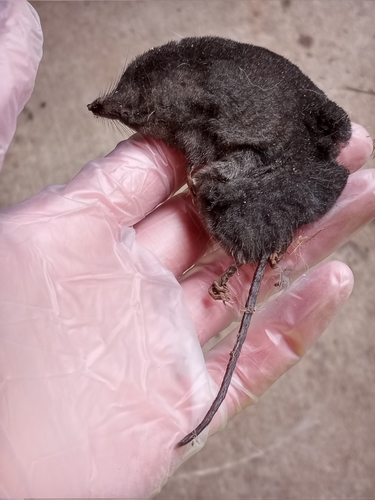
Bendire's Shrew
Sorex bendirii
Witness the 'Jesus Shrew' of the Pacific Northwest—a sleek, dark-furred diver that can literally run on water. This elusive riparian specialist is a master of the misty stream banks from British Columbia to California.
Quick Identification
Size
Total length 15-17 cm (5.9-6.7 in); weight 10-21 g (0.35-0.74 oz)
Colors
Uniformly dark chocolate brown to soot-black fur; slightly paler grayish-brown on the belly; dark, sparsely haired tail
Key Features
- Largest North American member of the Sorex genus
- Stiff fringe of bristles on the hind feet for swimming
- Velvety, water-repellent dark fur
- Long, pointed snout and tiny eyes
When You’ll See Them
Geographic range
Where Does the Bendire's Shrew Live?
Native to the coastal regions of the Pacific Northwest in North America, the Bendire's Shrew is a West Coast specialist. Its core range extends from southwestern British Columbia in Canada, southward through the western portions of Washington and Oregon, reaching its southern limit in the humid redwood forests of Northern California. These shrews are almost exclusively found west of the Cascade Mountains, thriving in the moisture-rich environments of the Pacific temperate rainforests.
Basemap © OpenStreetMap contributors
Behavior
The Bendire's Shrew is a remarkable semi-aquatic specialist, often nicknamed the 'Jesus shrew' for its incredible ability to run across the surface of the water for several seconds. This feat is possible thanks to air bubbles trapped in the stiff hairs on its feet, which provide just enough buoyancy and surface tension for the shrew to scurry over the water before sinking. They are highly energetic animals with a metabolic rate so high they must forage almost around the clock, alternating between short bursts of intense activity and brief periods of rest.
On land, they are secretive and move through dense undergrowth or tunnels in the leaf litter. In the water, they are proficient divers, using their sensitive whiskers to detect prey along the bottom of streams. While they are generally solitary and territorial, they rarely interact with humans due to their preference for thick, wet habitats. If encountered, they are likely to dive underwater or vanish into the mud at the first sign of movement.
EverydayEarth exclusive
Camera Tips
To capture a Bendire's Shrew on camera, you must focus on the 'splash zone.' Place your camera at the very edge of a small stream or within a marshy bog, aimed at a flat log or a muddy path through the reeds. These shrews follow predictable runways, so look for tiny, well-worn paths in the moss or mud. Position the camera extremely low—no more than 2-4 inches off the ground—and ensure the focal point is close, as these animals are small and stay low to the earth.
Because shrews are incredibly fast, your camera settings are critical. Use a camera with a trigger speed of 0.2 seconds or faster. If your device allows it, set it to take a rapid-fire sequence of 3-5 photos or a short high-definition video. Shrews are often just a 'brown blur' in standard trail cam shots, so a high frame rate is the only way to get a clear image of their features. Macro lens attachments can also be a game-changer for such small subjects.
Scent is the best way to get a Bendire's Shrew to pause long enough for a photo. A small amount of wet cat food or a cotton ball soaked in fish oil placed inside a small section of PVC pipe (a 'bait station') will encourage the shrew to investigate. This keeps the animal in the frame and provides a consistent focal point. Be sure to check your camera frequently in rainy weather, as their preferred habitats are prone to flash flooding which can submerge or wash away your gear.
Similar Species
Species that look similar or are commonly confused with Bendire's Shrew.
Frequently Asked Questions
Record Bendire's Shrew at your habitat
Connect a camera to start building your own species record — AI identifies every visitor automatically.