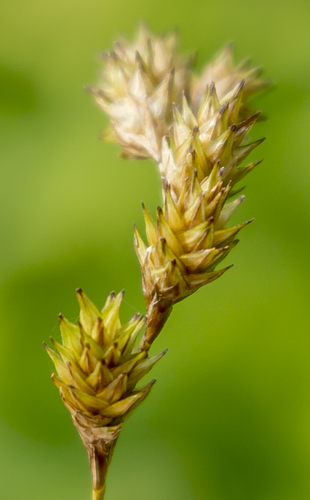
Bicknell's Sedge
Carex bicknellii
A sophisticated prairie native known for its shimmering copper seed heads and tidy clumping habit. Bicknell's Sedge adds a metallic glow and essential habitat to any sun-drenched backyard meadow.
Quick Identification
Size
Height ranges from 30 to 90 cm (12 to 36 inches); individual clumps usually remain under 30 cm (12 inches) in width.
Colors
Features vibrant blue-green foliage; seed heads (perigynia) transition from lime green to a striking metallic copper or golden-brown as they ripen.
Key Features
- Distinctive copper-colored, winged seed scales
- Tight clumping habit with usually fewer than 25 stems per plant
- Stiff, slender stems that hold seed heads upright
- Flat, narrow grass-like leaves
When You’ll See Them
Geographic range
Where Does the Bicknell's Sedge Live?
Bicknell's Sedge is native to North America, primarily concentrated in the central and eastern regions of the continent. Its core range stretches across the Midwestern United States—from the Great Plains of Kansas and Nebraska eastward to the Ohio River Valley—and extends north into southern parts of Ontario and Manitoba, Canada. While common in the heart of the prairie states, it is increasingly being introduced to suburban rain gardens and restoration projects across the Northeast.
Basemap © OpenStreetMap contributors
Behavior
Bicknell's Sedge is a perennial, clump-forming plant that follows a 'cool-season' growth pattern, meaning it does most of its growing during the milder temperatures of spring and autumn. Unlike many aggressive meadow grasses that spread via underground runners, this sedge is well-behaved, staying in discrete, tidy bunches that make it a favorite for native plant enthusiasts and backyard gardeners alike.
While it may appear stationary, it plays a dynamic role in the local ecosystem. In late spring, it produces inconspicuous flowers that are wind-pollinated, which then develop into the ornate seed heads that give the plant its 'copper-shouldered' nickname. It serves as a structural backbone for prairies, providing essential cover for ground-nesting insects and small mammals throughout the changing seasons.
EverydayEarth exclusive
Camera Tips
Capturing the subtle beauty of Bicknell's Sedge requires a different approach than filming wildlife. Because the 'copper' seed heads are the star of the show, position your camera at a low angle, roughly 12 to 18 inches off the ground. This 'worm's-eye view' highlights the architectural structure of the stems against the sky. For the best color saturation, aim for the 'golden hour'—the hour after sunrise or before sunset—when the low light catches the translucent edges of the copper perigynia, making them appear to glow from within.
To see the plant's interaction with the environment, set your AI camera to a time-lapse mode during the late spring (May and June). This allows you to witness the fascinating transition from green flowering spikes to the rich metallic brown of the mature seeds. If your camera has a macro lens or high-resolution sensor, try to focus on the individual seed scales; their unique heart-shaped, winged structure is a key diagnostic feature that looks incredible in close-up photography.
Background is everything with fine-textured plants like sedges. Try to place the camera so the sedge is backed by a darker, shaded area or a solid fence; this prevents the thin stems from getting 'lost' in a busy background of other grasses. If you are using a trail camera to monitor biodiversity, place it near a clump of Bicknell's Sedge during the winter. Because it maintains some structure even when dormant, you will often catch birds like juncos or sparrows foraging for fallen seeds around the base of the plant.
Similar Species
Species that look similar or are commonly confused with Bicknell's Sedge.
Frequently Asked Questions
Record Bicknell's Sedge at your habitat
Connect a camera to start building your own species record — AI identifies every visitor automatically.