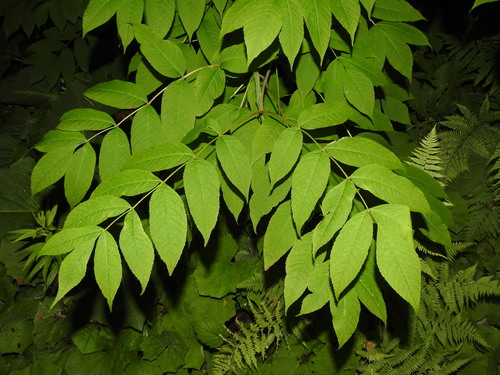
black ash
Fraxinus nigra
A champion of the wetlands, the Black Ash is a vital tree that thrives where other hardwoods fail. While currently facing an existential threat from invasive pests, it remains a cultural and ecological cornerstone of the northern forests.
Quick Identification
Size
Typically reaches 40-60 feet (12-18 meters) in height with a trunk diameter of 1-2 feet (30-60 cm).
Colors
Light gray, corky bark; dark green leaflets; distinctive purplish-black winter buds.
Key Features
- Sessile leaflets (attached directly to the leaf stem without stalks)
- Spongy, corky bark that crumbles when rubbed
- Opposite branching and leaf arrangement
- Dark, almost black terminal buds
- Flat, winged seeds (samaras) with a notched tip
When You’ll See Them
Geographic range
Where Does the black ash Live?
The Black Ash is native to the temperate regions of North America, flourishing across a broad swath of eastern Canada and the northeastern United States. Its territory extends from the western shores of Newfoundland across to southeastern Manitoba, reaching southward into the Great Lakes region and down to the high elevations of northern Virginia and Illinois. You will primarily find this species in low-lying damp areas where other hardwood trees are unable to compete with the high water table.
Basemap © OpenStreetMap contributors
Behavior
The Black Ash is a slow-growing, deciduous hardwood that is uniquely adapted to life in saturated soils. Unlike its cousins, the White and Green Ash, this species thrives in 'wet feet' conditions, often standing in water for much of the growing season. It is one of the last trees to produce leaves in the spring and among the first to shed them in the autumn, creating a shorter but intense period of growth during the summer months.
Ecologically, the Black Ash acts as a foundational species in forested wetlands. Its canopy provides essential nesting sites for riparian birds, while its seeds are a significant food source for wood ducks, wild turkeys, and small mammals. Its wood is unique among North American trees because it lacks the fibers that connect growth rings, allowing the wood to be easily split into thin, flexible strips when pounded.
In recent years, the 'behavior' of Black Ash populations has been defined by their struggle against the invasive Emerald Ash Borer (EAB). This beetle has devastated the species, leading to a massive decline in mature trees. Observations today often focus on identifying 'lingering ash'—rare individuals that show potential resistance to the infestation.
EverydayEarth exclusive
Camera Tips
When setting up an AI camera to capture the Black Ash, focus on the unique texture of its bark and the base of the trunk. Because this tree grows in wet, boggy environments, standard ground stakes may not be stable. Use a tree mount or a specialized tripod designed for soft mud. Position the camera at chest height to capture the 'corky' bark texture, which is a primary identification feature. If your camera has a macro or close-up setting, use it to document the dark, soot-colored buds during late winter, as these are very distinctive for the species.
To photograph the wildlife that interacts with the Black Ash, aim your lens at the lower trunk or the water-filled depressions at its roots. These 'micro-pools' often attract amphibians like wood frogs or spotted salamanders. During late summer, when the winged samaras (seeds) are ripening, consider angling a camera toward the lower canopy. This is a great way to capture wood ducks or squirrels that visit the tree specifically to forage on the seeds.
Because the Black Ash is under threat from the Emerald Ash Borer, your camera can serve as a vital monitoring tool. Set your camera to high-sensitivity motion detection to capture 'blondeing' behavior—where woodpeckers vigorously strip the outer bark to reach beetle larvae. This bark-stripping creates a bright patch that is easily visible on camera. Recording these interactions helps researchers track the spread of the borer and the health of the local tree population.
Lighting in swamps can be tricky due to the dense canopy. For the best results, use a camera with a high-quality infrared (IR) flash for nighttime shots of nocturnal visitors like raccoons or opossums that use the tree for shelter. During the day, aim for the golden hours of morning or late afternoon when the sun hits the light-gray bark, making it pop against the darker background of the wetland.
Similar Species
Species that look similar or are commonly confused with black ash.
Frequently Asked Questions
Record black ash at your habitat
Connect a camera to start building your own species record — AI identifies every visitor automatically.