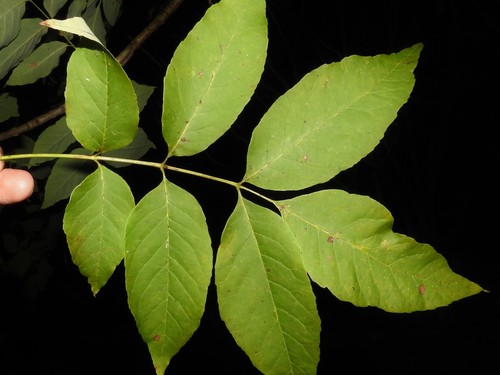
white ash
Fraxinus americana
The white ash is the crown jewel of the American hardwood forest, famous for its grand stature and its role as the source of the classic wooden baseball bat. Its distinctive diamond-patterned bark and vibrant autumn hues make it a centerpiece for any backyard wildlife sanctuary.
Quick Identification
Size
Typically 21–30 m (70–100 ft) tall with a trunk diameter of 0.6–1.5 m (2–5 ft); record specimens can reach 45 m (150 ft).
Colors
Ash-gray to gray-brown bark; dark green leaves with silver-white undersides; fall colors ranging from deep purple to yellow.
Key Features
- Opposite branching pattern where twigs and leaves grow in pairs
- Compound leaves usually containing 7 leaflets with short stalks
- Bark on mature trees has deep, diamond-shaped interlacing ridges
- Winged seeds (samaras) shaped like canoe paddles that hang in clusters
When You’ll See Them
Behavior
The white ash is a foundational species in North American forests, known for its rapid growth and stately, symmetrical crown. Unlike many other hardwoods, it maintains a strong, straight central trunk, making it a favorite for both timber and urban landscaping. It is 'dioecious,' meaning individual trees are either male or female, with the females producing the iconic winged seeds that swirl to the ground in late autumn.
Ecologically, the white ash acts as a vital hub for backyard biodiversity. Its bark provides deep crevices for hibernating insects, which in turn attract a variety of insectivorous birds. In the spring, its inconspicuous flowers provide an early nectar source for bees, while its seeds are a high-energy food source for wood ducks, finches, and squirrels during the lean winter months.
EverydayEarth exclusive
Camera Tips
When monitoring a white ash with a trail camera, your goal isn't just the tree itself, but the 'wildlife highway' it creates. Mount your camera on a nearby structure or a different tree facing the ash’s main trunk at a height of about 5–6 feet. This allows you to capture the various woodpecker species, such as the Pileated or Downy Woodpecker, that frequently probe the diamond-ridged bark for larvae. If the tree is younger with lower branches, aim your camera at a 45-degree downward angle to catch squirrels and chipmunks gathering fallen samaras on the ground.
Lighting is critical for capturing the tree's unique texture. Position your camera to the south of the tree to take advantage of the 'golden hour' light, which highlights the deep furrows of the bark and the silvery undersides of the leaves as they flutter in the wind. In late autumn, adjust your trigger sensitivity to 'High' to capture the rapid movement of birds feeding on the seed clusters before they drop.
During the winter, the white ash is an excellent spot for capturing nocturnal activity. Many small mammals use the base of the ash for shelter. If you are looking for evidence of the Emerald Ash Borer, a devastating invasive beetle, set your camera for high-resolution stills. Look for 'blonde' patches where woodpeckers have stripped the outer bark to reach the larvae underneath; this color contrast shows up vividly on modern AI-powered cameras.
Similar Species
Species that look similar or are commonly confused with white ash.
Frequently Asked Questions
Record white ash at your habitat
Connect a camera to start building your own species record — AI identifies every visitor automatically.