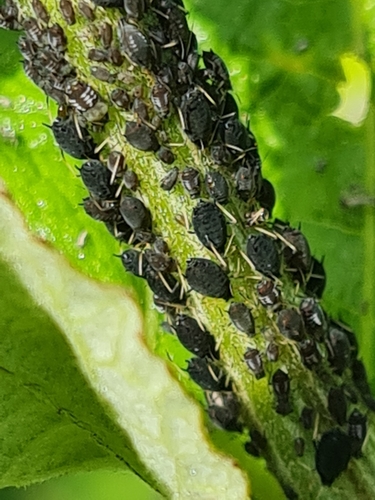
Black Bean Aphid
Aphis fabae
The Black Bean Aphid is a tiny marvel of the garden world, known for its incredible reproductive speed and its fascinating partnership with 'farming' ants. While often viewed as a pest, their complex life cycle and social interactions make them a captivating subject for backyard observation.
Quick Identification
Size
Tiny, measuring approximately 2–3 mm (0.08–0.12 inches) in length.
Colors
Dull matte black or very dark olive green; nymphs may have white waxy spots on the abdomen.
Key Features
- Broad, pear-shaped soft body
- Short dark cornicles (tail-pipes) at the rear
- Often found in dense, crowded clusters on stems
- White waxy secretions occasionally visible on the back
When You’ll See Them
Geographic range
Where Does the Black Bean Aphid Live?
Originally native to Europe and parts of Asia, the Black Bean Aphid has successfully expanded its territory to become a cosmopolitan species. Today, it is found across the temperate regions of North America, South America, and Africa, largely following the global spread of agriculture. You can expect to find them in almost any backyard garden or farm field across the United States, Canada, and the United Kingdom where their favorite host plants thrive.
Basemap © OpenStreetMap contributors
Behavior
The Black Bean Aphid is a master of rapid colonization. During the spring and summer, these insects are famous for their 'telescoping generations,' where females give birth to live young that are already developing their own offspring. This leads to explosive population growth, often covering the tender stems and undersides of leaves on host plants like broad beans, poppies, and nasturtiums. Their feeding involves piercing plant tissues to suck out nutrient-rich phloem sap, which can cause leaves to curl and shoots to become stunted.
One of the most fascinating aspects of their behavior is their symbiotic relationship with ants. As the aphids consume sap, they excrete a sugary liquid called honeydew. Ants 'farm' the aphids, stroking them with their antennae to stimulate honeydew production and, in exchange, the ants act as aggressive bodyguards, fending off predators like ladybugs and lacewings. In the autumn, the population transitions from wingless clones to winged individuals that migrate to woody shrubs to lay eggs for the winter.
EverydayEarth exclusive
Camera Tips
Capturing the Black Bean Aphid requires a specialized approach because of their minute size. To get clear shots, you must use a camera with macro capabilities or a dedicated macro lens attachment. Standard trail cameras are usually focused too far away; instead, position your AI-powered backyard camera or smartphone lens within 5 to 10 centimeters of the target plant. Look for 'hotspots' like the growing tips of broad bean plants or the undersides of nasturtium leaves.
Stability is your biggest challenge. Even a light breeze will move the plant stem out of your narrow depth of field. Use a small stake to steady the plant or choose a sheltered corner of the garden. If you are using a camera with motion triggers, set the sensitivity to high, though it is often more effective to use time-lapse modes or manual triggers when you see the colony is active.
Lighting can make or break an aphid photo. Mid-morning light is ideal as it provides enough brightness to see their dark bodies without the harsh shadows of midday. Backlighting—positioning the sun behind the leaf—can create a beautiful glow through their bodies and highlight the glistening droplets of honeydew they produce. Finally, keep an eye out for ants; if you see ants running up and down a stem, they are likely leading you right to an aphid colony.
Similar Species
Species that look similar or are commonly confused with Black Bean Aphid.
Frequently Asked Questions
Record Black Bean Aphid at your habitat
Connect a camera to start building your own species record — AI identifies every visitor automatically.