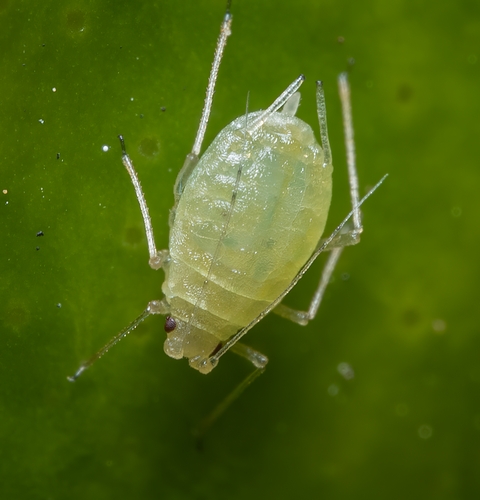
Green Peach Aphid
Myzus persicae
The Green Peach Aphid is a tiny but mighty force in the garden, capable of building massive colonies through the power of cloning. Often hidden beneath leaves, these translucent insects are a vital part of the backyard food web, feeding everything from ladybugs to lacewings.
Quick Identification
Size
1.2 to 2.3 mm (0.05 to 0.09 inches) in length
Colors
Typically pale green to yellowish-green; winged adults have a dark head and thorax with a black patch on the abdomen
Key Features
- Pear-shaped, soft body
- Pair of tube-like cornicles (tailpipes) at the rear
- Distinctive inward-pointing bumps (tubercles) at the base of the antennae
- Often found in dense clusters on leaf undersides
When You’ll See Them
Behavior
The Green Peach Aphid is a master of survival through rapid multiplication. During the summer months, these insects reproduce via parthenogenesis, meaning females give birth to live young that are essentially clones of themselves. This allows a single aphid to found a massive colony on a garden plant in a remarkably short amount of time. They are primarily found on the undersides of leaves, where they use needle-like mouthparts to pierce plant tissues and drink the nutrient-rich sap.
These aphids are famous for their complex life cycle, which often involves switching hosts. They typically overwinter as eggs on peach or cherry trees, but move to hundreds of different vegetable and ornamental plants during the growing season. Their presence is often revealed by the 'honeydew' they excrete—a sticky substance that can attract ants and promote the growth of black sooty mold on leaves.
EverydayEarth exclusive
Camera Tips
To capture the Green Peach Aphid on camera, you must think small. Standard backyard trail cameras usually have a minimum focus distance of several feet, which will leave an aphid looking like a tiny green blur. To get a usable shot, you will need a camera with a dedicated macro lens or a 'super macro' setting. If you are using a smartphone-based AI camera, look for clip-on macro attachments that allow you to focus within an inch or two of the leaf surface.
Positioning is everything. Rather than searching randomly, look for 'indicator species.' If you see ants marching up and down a plant stem or ladybugs patrolling a leaf, there is a high probability of an aphid colony nearby. Mount your camera on a small flexible tripod and aim it at the underside of a leaf on a host plant like a pepper or kale. Use a high f-stop (small aperture) if possible to increase the depth of field, as even a slight breeze can move the leaf out of focus.
Lighting is the final piece of the puzzle. Aphids have somewhat translucent bodies that can appear 'blown out' in direct sunlight. The best time to photograph them is during the early morning or on an overcast day when the light is naturally diffused. If you are shooting in bright sun, use a piece of white paper or a small diffuser to cast a soft shadow over the colony. This will reveal the intricate details of their cornicles and antennae that are essential for a positive AI identification.
Similar Species
Species that look similar or are commonly confused with Green Peach Aphid.
Frequently Asked Questions
Record Green Peach Aphid at your habitat
Connect a camera to start building your own species record — AI identifies every visitor automatically.