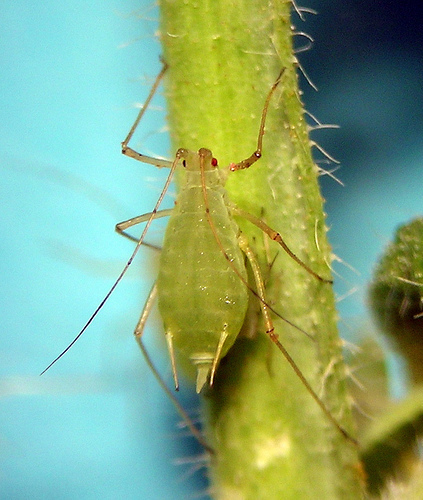
Pea Aphid
Acyrthosiphon pisum
The Pea Aphid is a tiny, translucent wonder of the garden world, known for its incredible reproductive speed and its role as a vital food source for beneficial insects. Often found in shades of mint green or soft pink, these 'sap-suckers' turn garden plants into bustling miniature metropolises.
Quick Identification
Size
Length of 2.5 to 4.5 mm (0.1 to 0.18 inches); one of the larger aphid species found in backyards.
Colors
Typically a pale, translucent mint-green, though a pink or reddish morph also exists; features prominent red eyes.
Key Features
- Pear-shaped, soft body with unusually long legs and antennae
- Two long, thin tubes (cornicles) extending from the rear
- Distinct reddish eyes that contrast with the body color
- Long, slender cauda (tail-like structure) at the tip of the abdomen
When You’ll See Them
Behavior
Pea Aphids are remarkably social insects that spend their lives in dense colonies, typically found on the stems and undersides of leaves. They are phloem-feeders, using specialized mouthparts to pierce plant tissues and drink sugar-rich sap. Because they consume so much sugar, they excrete a sticky substance called honeydew, which often attracts ants that 'farm' the aphids for this sweet treat.
Their reproductive strategy is a marvel of nature. For most of the summer, females produce live young through parthenogenesis (cloning themselves without mating). This allows populations to explode almost overnight. Interestingly, Pea Aphids have a 'drop' response to danger; if they feel the breath of a grazing animal or the vibrations of a predator like a ladybug, they will collectively tumble off the plant to the safety of the soil below.
EverydayEarth exclusive
Camera Tips
Capturing the Pea Aphid requires a shift in perspective, as these tiny insects are far smaller than your typical trail camera subject. To successfully document them, you must use a camera with macro capabilities or a dedicated macro lens attachment. Focus your lens on the tender new growth of host plants like sweet peas or clover. Since these insects are nearly stationary while feeding, you don't need a fast shutter speed, but you will need a tripod to keep the frame steady at high magnifications.
For the best visual results, try 'backlighting' the aphids. Because their bodies are translucent, placing the camera so the sun shines through the leaf or from behind the stem will make the aphids glow, highlighting their internal structures and red eyes. If your AI camera has a time-lapse mode, set it to take a photo every 10-15 minutes over several days. This allows you to witness the incredible speed of their colony growth and the fascinating way they shift positions as the plant grows.
Don't just look for the aphids; look for their predators. Position your camera near an aphid colony to catch high-stakes backyard drama. You are likely to film ladybugs, lacewings, or hoverfly larvae arriving to feast. These interactions happen slowly enough that a standard frame rate will capture the action beautifully. If you are using a motion-triggered camera, ensure it is set to its highest sensitivity and placed within 6-12 inches of the plant, provided the camera can focus at that range.
Similar Species
Species that look similar or are commonly confused with Pea Aphid.
Frequently Asked Questions
Record Pea Aphid at your habitat
Connect a camera to start building your own species record — AI identifies every visitor automatically.