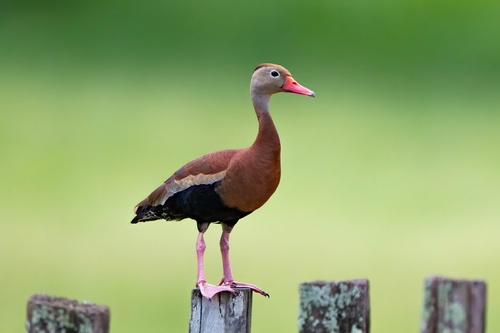
Black-bellied Whistling-Duck
Dendrocygna autumnalis
With its vibrant red bill, long pink legs, and a habit of perching in trees like a songbird, the Black-bellied Whistling-Duck is one of the most unique and vocal visitors to suburban wetlands across the Americas.
Quick Identification
Size
Length: 18-21 in (47-53 cm); Wingspan: 30-37 in (76-94 cm); Weight: 1.5-2.2 lbs (650-1000 g)
Colors
Distinctive chestnut-brown body and neck with a contrasting black belly; grey face; bright coral-red bill and long pink legs. Males and females are identical in appearance.
Key Features
- Bright coral-red or pink bill and long pink legs
- Solid black belly and underside
- Large white wing patches visible in flight
- Long, goose-like neck and upright posture
When You’ll See Them
Sightings on EverydayEarth
Jun 2, 2026
Three Black-bellied Whistling-Ducks are perched on the edge of the floating manatee feeding structure, known as a salad bar. They remain relatively still, occasionally turning their heads to observe the surrounding water.
Apr 20, 2026
A pair of Black-bellied Whistling-Ducks are resting on a floating pipe in the waterway. The duck in the foreground is active, frequently turning its head and adjusting its posture, while a second individual is perched close behind it. The surrounding water is calm, reflecting the dense canopy of trees in the early morning light.
Apr 17, 2026
Two Black-bellied Whistling-Ducks are perched on a floating black frame in the middle of the water. One duck is actively grooming its wing feathers, while the other stands still, observing the surrounding wetland habitat. The water surface is calm, reflecting the overhead canopy of trees.
Apr 14, 2026
A group of Black-bellied Whistling Ducks is gathered on a floating structure in the clear waters of Homosassa Springs. Several ducks are perched on the frame, alertly scanning their surroundings, while another individual swims nearby. The calm water reflects the surrounding forest canopy in the fading evening light.
Geographic range
Where Does the Black-bellied Whistling-Duck Live?
Native to the Americas, the Black-bellied Whistling-Duck is a highly successful species that ranges from the southern United States through Mexico and Central America, extending deep into South America as far as northern Argentina. In the United States, they are year-round residents of Texas, Louisiana, and Florida, but have recently expanded their breeding range northward into the Carolinas, Georgia, and even the Midwest. They are primarily a lowland species, favoring tropical and subtropical climates with easy access to standing water.
Basemap © OpenStreetMap contributors
Behavior
The Black-bellied Whistling-Duck is a highly social and boisterous waterfowl species, famous for its namesake high-pitched, whistling calls that often echo through the night. Unlike most ducks, they are quite comfortable perching on tree branches, fences, and even rooftops, a trait that earned them the nickname 'tree ducks.' They form strong, long-term pair bonds and are frequently seen in large, gregarious flocks outside of the breeding season.
These ducks are primarily crepuscular and nocturnal, spending much of the daylight hours resting and becoming highly active at dusk. They are surprisingly bold around human habitation, often frequenting suburban parks, golf courses, and backyard ponds. Their flight is distinctive, with slow, heavy wingbeats that reveal broad white stripes against their dark wings.
EverydayEarth exclusive
Camera Tips
To capture the best footage of Black-bellied Whistling-Ducks, place your AI-powered camera near the edge of a freshwater pond or a large, stable bird bath. Because they are significantly more active after the sun goes down, it is crucial to use a camera with high-quality infrared night vision or a low-glow flash that won't startle the flock. Position the camera at a low angle, about 1 to 2 feet off the ground, to catch their unique 'walking' gait and the detail of their pink legs as they forage near the water's edge.
If you have large trees near water, consider mounting a camera higher up—roughly 10 to 15 feet—facing a sturdy horizontal branch or a wood duck nesting box. These ducks are cavity nesters and will frequently visit these spots during the spring (typically March through June). A wide-angle lens is ideal here, as it captures the clumsy but charismatic way they land on branches, which is a rare sight for most duck species. High sensitivity settings are recommended to trigger the camera when they fly into the frame.
Attracting them to a specific spot is relatively easy if you have a lawn or platform. Scattering cracked corn or poultry grain on a low platform feeder near water is almost a guarantee for a visit. Since they travel in large, noisy groups, set your camera to take 'burst' photos or 15-20 second videos. This allows the AI to capture the complex social interactions and the beautiful white wing patches that are only visible when they stretch or take flight.
Similar Species
Species that look similar or are commonly confused with Black-bellied Whistling-Duck.
Fulvous Whistling-Duck
Lacks the red bill and black belly; has an overall warm tawny-brown color and a dark bill.
Wood Duck
While it also nests in trees, the male Wood Duck has much more intricate, iridescent plumage and a distinct crest, whereas Whistling-Ducks have longer legs and a goose-like profile.
Frequently Asked Questions
Record Black-bellied Whistling-Duck at your habitat
Connect a camera to start building your own species record — AI identifies every visitor automatically.