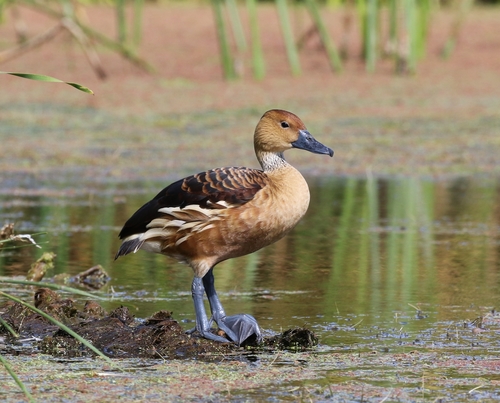
Fulvous Whistling-Duck
Dendrocygna bicolor
With its elegant long neck and warm cinnamon plumage, the Fulvous Whistling-Duck is a social wanderer of the world's wetlands. Known for its melodic whistling call and lifelong partnerships, this striking bird is a favorite for backyard observers near the water's edge.
Quick Identification
Size
45-53 cm (18-21 in) long; 85-93 cm (33-37 in) wingspan; 700-1,000 g (1.5-2.2 lbs)
Colors
Rich tawny or cinnamon-brown body, dark brown back with buff scalloping, blue-grey bill and legs, white stripe on flanks
Key Features
- Upright, long-necked silhouette with long blue-grey legs
- Creamy-white 'racing stripe' along the side of the body
- Uniformly cinnamon-colored underparts and neck
- White 'V' shape on the rump visible during flight
When You’ll See Them
Geographic range
Where Does the Fulvous Whistling-Duck Live?
The Fulvous Whistling-Duck is a true global traveler, native to tropical and subtropical regions across four continents. It maintains a strong presence in the southern United States, Mexico, and South America, while separate populations thrive across sub-Saharan Africa and the Indian subcontinent. Because they are highly nomadic and follow seasonal rainfall, these ducks are known to appear unexpectedly in new wetland areas far from their core breeding grounds.
Basemap © OpenStreetMap contributors
Behavior
The Fulvous Whistling-Duck is a highly social and gregarious waterfowl, often found in large, noisy flocks. Unlike many other duck species, these birds form strong pair bonds that often last for life, and both parents share the responsibilities of incubating eggs and raising their young. They are named for their distinctive, multi-syllabic whistling call, which they use frequently to communicate with the flock while in flight or when startled.
These ducks are primarily nocturnal or crepuscular, meaning they are most active during the night and the hours surrounding dawn and dusk. During the day, they can be seen resting in large groups on muddy banks or in shallow water, often standing tall on their unusually long legs to scan for predators. They are generally peaceful but can be quite chatty, filling the air with soft whistles as they interact with one another.
EverydayEarth exclusive
Camera Tips
To capture high-quality footage of the Fulvous Whistling-Duck, position your camera at a low angle, roughly 6 to 12 inches above the ground. These ducks spend significant time standing on muddy banks or wading in very shallow water, so a low-profile setup will provide an intimate, eye-level perspective of their unique long-necked silhouette. If you have a backyard pond or a marshy edge, mounting the camera on a short stake near the water's edge is ideal.
Because this species is primarily active during the 'golden hours' and throughout the night, ensure your camera has excellent infrared night vision or low-light sensors. They are most likely to visit feeding sites between dusk and dawn. If you are using a trigger-based camera, set it to record video clips of at least 15-20 seconds. Since they travel in flocks, a single photo will often miss the social interactions and the 'follow-the-leader' behavior typical of the species.
While they don't visit traditional bird feeders, you can encourage them to stay within your camera's frame by ensuring there is a clear patch of shallow, muddy water or by providing a low-profile water feature. They are highly attracted to areas with aquatic vegetation or spilled grain. In suburban areas near wetlands, they may visit flooded lawns after heavy rain, making these temporary 'puddles' excellent spots for a temporary camera placement during the wet season.
Similar Species
Species that look similar or are commonly confused with Fulvous Whistling-Duck.
Black-bellied Whistling-Duck
Has a bright pink bill and a black belly, whereas the Fulvous has a grey bill and tawny underparts.
West Indian Whistling-Duck
Larger and darker with heavy spotting on the flanks, unlike the uniform cinnamon of the Fulvous.
Cinnamon Teal
Much smaller with a typical 'duck' shape; lacks the long neck and long legs of the whistling-duck.
Frequently Asked Questions
Record Fulvous Whistling-Duck at your habitat
Connect a camera to start building your own species record — AI identifies every visitor automatically.