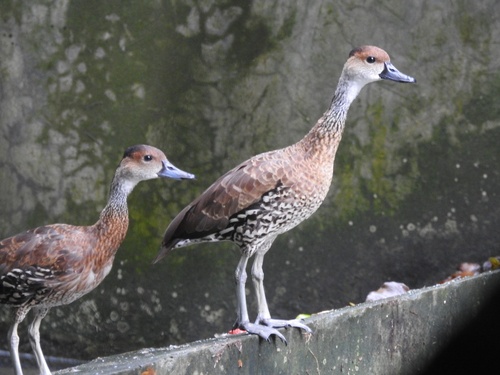
West Indian Whistling-Duck
Dendrocygna arborea
A rare and elegant Caribbean resident, the West Indian Whistling-Duck is famous for its haunting nightly calls and its unusual habit of perching high in palm trees. With its striking spotted plumage and long-necked silhouette, it is a crown jewel of tropical wetland ecosystems.
Quick Identification
Size
48–58 cm (19–23 in) in length; wingspan of 70–90 cm (27.5–35.5 in); weight 0.8–1.3 kg (1.8–2.9 lbs)
Colors
Rich chocolate-brown body with prominent white spots on the flanks and belly; grayish-brown neck and a distinct black bill. Males and females look identical.
Key Features
- Distinctive black bill and dark legs
- Large white spots on belly and flanks
- Long, elegant neck with an upright posture
- Loud, multi-syllabic whistling call
When You’ll See Them
Geographic range
Where Does the West Indian Whistling-Duck Live?
This bird is a Caribbean specialist, found exclusively across the islands of the West Indies. Its core populations are concentrated in the Bahamas, Cuba, Jamaica, Hispaniola, and Puerto Rico, with smaller numbers inhabiting the Cayman Islands and parts of the Lesser Antilles. It is a non-migratory resident, staying within these tropical island ecosystems year-round.
Basemap © OpenStreetMap contributors
Behavior
The West Indian Whistling-Duck is a primarily nocturnal and crepuscular species, spending its daylight hours hidden in the safety of dense mangroves or perched high within the canopy of palm trees. Unlike most ducks, they are highly arboreal, using their long toes to grip branches with surprising agility. As the sun sets, they become much more active, often flying in small, noisy flocks toward their favorite foraging grounds.
Socially, these ducks are quite gregarious but remain wary of human presence due to historical hunting. They are famous for their namesake whistle—a high-pitched 'cher-vvee'—which they use to communicate with the flock while in flight. While they don't perform long-distance migrations, they are known to be local wanderers, shifting their range based on the availability of seasonal water sources and fruiting palm trees.
EverydayEarth exclusive
Camera Tips
To capture the West Indian Whistling-Duck on a trail camera, focus on transition zones where dense vegetation meets shallow water. Because these birds are most active after dark, a camera with a high-quality, 'no-glow' infrared flash is essential to avoid spooking them. Position your camera about 2 feet off the ground, angled toward muddy banks or the edges of mangrove lagoons where they come to drink and preen.
One of the best ways to attract this species to your camera site is by placing it near a stand of Royal Palms. When the palm fruit falls, these ducks will often gather on the ground at night to feed. Clearing a small patch of ground near these trees can provide a clear line of sight for your lens. If you are near a pond, look for 'ramps'—shallow spots where the ducks can easily walk out of the water.
Setting your camera to video mode is highly recommended for this species. Their social interactions and distinct whistling calls are just as interesting as their appearance. Use a fast trigger speed, as they can be surprisingly quick when moving from water to land. Since they are year-round residents, consistency is key; keep your camera active during the dry season when birds are forced to congregate around fewer permanent water holes.
Similar Species
Species that look similar or are commonly confused with West Indian Whistling-Duck.
Frequently Asked Questions
Record West Indian Whistling-Duck at your habitat
Connect a camera to start building your own species record — AI identifies every visitor automatically.