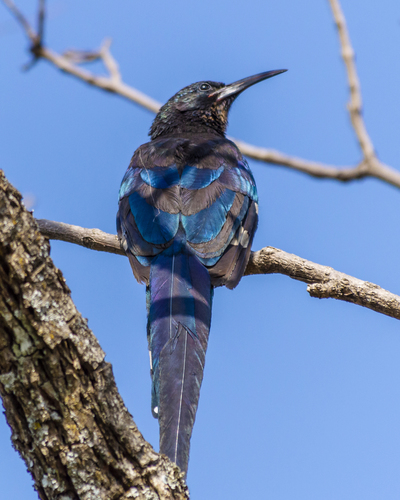
Black-billed Woodhoopoe
Phoeniculus somaliensis
With its shimmering iridescent plumage and a long, curved bill, the Black-billed Woodhoopoe is a charismatic highlight of the East African landscape. This social bird is most famous for its noisy group 'rallies' and its incredible ability to climb and forage along tree trunks with acrobatic ease.
Quick Identification
Size
30–38 cm (12–15 inches) in length; weighs approximately 50–90g (1.8–3.2 oz)
Colors
Glossy dark plumage with iridescent purple and green highlights; black bill and legs; white bands on wings and white spots on the tail tips
Key Features
- Long, decurved black bill
- Iridescent purple-green shimmering feathers
- Long, graduated tail with white terminal spots
- Social behavior, often seen in noisy groups
When You’ll See Them
Geographic range
Where Does the Black-billed Woodhoopoe Live?
Native to the diverse landscapes of Eastern Africa, the Black-billed Woodhoopoe is a resident species primarily found throughout the Horn of Africa. Its core range spans Ethiopia, Somalia, and northern Kenya, extending into parts of Djibouti, Eritrea, and South Sudan. Unlike some migratory species, these birds remain in their territories year-round, favoring the region's wooded valleys and scrubby highlands.
Basemap © OpenStreetMap contributors
Behavior
The Black-billed Woodhoopoe is an exceptionally social bird, rarely seen alone. They live in tight-knit family groups of up to a dozen individuals that engage in "cooperative breeding," where older siblings help the parents feed and protect the new chicks. These groups are highly vocal and perform a unique "rally" or greeting ceremony where they bob their bodies and cackle in unison, creating a distinctive cacophony that can be heard from a distance.
When foraging, these birds are remarkably agile, often clinging to the sides of tree trunks or hanging upside down from branches like nuthatches. They use their long, slender bills to probe deep into the crevices of bark to find hidden insects. Despite their somewhat shy nature in deep forests, they have adapted well to human-modified landscapes and can become quite bold in suburban gardens that offer plenty of mature trees and water.
EverydayEarth exclusive
Camera Tips
To capture the best footage of Black-billed Woodhoopoes, focus your camera placement on vertical surfaces rather than the ground. These birds spend the vast majority of their time on tree trunks. Mount your camera 1.5 to 2 meters high on a rough-barked tree like an Acacia or an old fruit tree. Angle the lens slightly downward to capture them as they work their way up the trunk probing for insects. Because their feathers are highly iridescent, avoid placing the camera in direct, harsh sunlight which can cause glare; instead, look for a spot with consistent, dappled shade to bring out those rich purple and green tones.
While they are not traditional feeder birds, Black-billed Woodhoopoes are very attracted to water. A raised birdbath or a dripper feature is an excellent way to lure a whole family group into your camera's field of view. They often bathe together, providing fantastic opportunities for social interaction footage. If you use suet feeders, place them near thick cover, as these birds prefer to have a quick escape route into the foliage if they feel threatened.
Set your AI-powered camera to 'burst mode' or high-frame-rate video. Woodhoopoes are constantly in motion—flicking their tails and bobbing their heads—and a standard single-shot setting might miss the moment they fan their tails to reveal those iconic white spots. Early morning is the peak time for activity when they first emerge from their roosting holes. If you find a cavity in a tree that they are using for nesting or sleeping, position your camera at least 4 meters away to avoid disturbing them while capturing their fascinating 'change of guard' behaviors.
Similar Species
Species that look similar or are commonly confused with Black-billed Woodhoopoe.
Frequently Asked Questions
Record Black-billed Woodhoopoe at your habitat
Connect a camera to start building your own species record — AI identifies every visitor automatically.