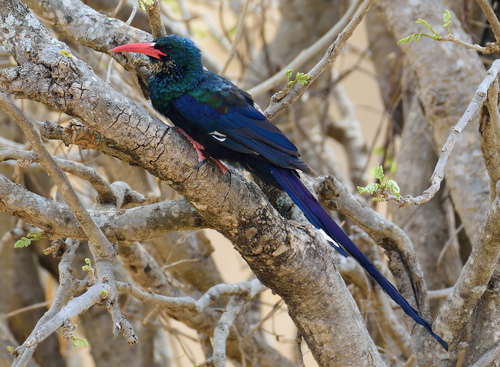
Green Woodhoopoe
Phoeniculus purpureus
With their iridescent emerald feathers and long, curved red bills, Green Woodhoopoes are among Africa's most charismatic backyard visitors. Known for their loud, cackling group 'rallies,' these social birds bring a burst of color and high-energy drama to any woodland garden.
Quick Identification
Size
Length of 30–44 cm (12–17 in); weight of 54–110 g (1.9–3.9 oz)
Colors
Iridescent dark green to violet-purple plumage; bright red bill and legs; white spots on wings and tail
Key Features
- Long, slender, decurved red bill
- Iridescent dark green and purple plumage
- White spots on the flight feathers and tail
- Loud, synchronized 'kak-kak-kak' cackling vocalizations
When You’ll See Them
Geographic range
Where Does the Green Woodhoopoe Live?
Native to the vast landscapes of Sub-Saharan Africa, the Green Woodhoopoe enjoys one of the most extensive ranges of any African woodland bird. They are found across a broad belt stretching from Senegal in the west to Ethiopia in the east, and southward through East Africa into South Africa. In their core range, they are particularly common in the bushy savannas and acacia woodlands of countries like Kenya, Zimbabwe, and South Africa, where they have adapted remarkably well to suburban parks and leafy residential areas.
Basemap © OpenStreetMap contributors
Behavior
Green Woodhoopoes are famously social birds, living in tight-knit family groups of up to a dozen individuals. They are best known for their 'rallying' behavior, where the entire group performs a synchronized display of rocking their bodies and producing a loud, rhythmic cackling sound that resembles laughter. This display serves to strengthen social bonds and defend their territory against rival groups.
They are highly active and acrobatic, often seen clinging to tree trunks or hanging upside down to probe into crevices for food. Unlike many other birds, they practice cooperative breeding, where non-breeding adult 'helpers' assist the dominant pair in feeding and protecting the chicks. Their presence in a backyard is usually announced by their noise before they are even seen.
EverydayEarth exclusive
Camera Tips
To capture the social dynamics of Green Woodhoopoes, focus your camera on vertical surfaces rather than bird baths. These birds are specialized 'crevice-gleaners,' meaning they spend most of their time patrolling the trunks and thick branches of mature trees. Position your camera about 5 to 7 feet off the ground, angled slightly upward toward a tree trunk known to have loose bark or hollows. Using a side-mount on a nearby tree or a tripod with a wide-angle lens will help you catch the entire group when they perform their characteristic group 'rallies.'
While they don't frequent traditional seed feeders, you can lure them into camera range by offering high-protein treats. Smearing suet or a specialized insect paste into the crevices of tree bark is much more effective than using a tray. This mimics their natural foraging behavior and will keep them in front of the lens longer as they work to extract the food. If you have an old log or a 'stumpery' in your yard, this is an ideal focal point for your AI camera, as woodhoopoes love to investigate decaying wood for grubs.
Timing is critical for getting clear, iridescent shots. Because their feathers are so dark and glossy, they can easily appear as black silhouettes in harsh midday sun. Set your camera's trigger sensitivity to high during the early morning and late afternoon when the golden hour light hits their feathers at a low angle, revealing the spectacular green and violet sheen. Since they are very vocal, if your camera has a 'sound-start' feature, it will likely be triggered by their loud cackling before they even land in the frame.
Similar Species
Species that look similar or are commonly confused with Green Woodhoopoe.
Frequently Asked Questions
Record Green Woodhoopoe at your habitat
Connect a camera to start building your own species record — AI identifies every visitor automatically.