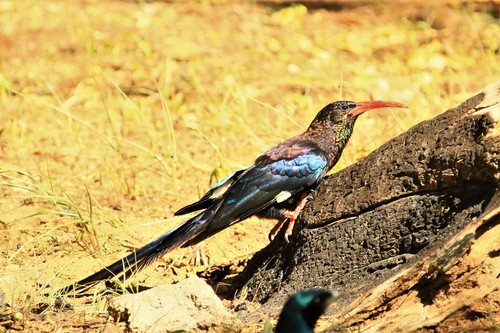
Violet Woodhoopoe
Phoeniculus damarensis
Meet the social butterfly of the African savanna. With its brilliant red bill and shimmering violet plumage, the Violet Woodhoopoe is a master of group harmony and acrobatic foraging.
Quick Identification
Size
32–36 cm (12.5–14 inches) in length; weight approximately 65–100g (2.3–3.5 oz)
Colors
Iridescent dark plumage with deep violet and coppery-purple mantle. Bright red decurved bill; white patches on wings and tail.
Key Features
- Long, downward-curved bright red bill
- Deep violet and coppery sheen on the mantle and back
- Long, graduated black tail with distinct white spots
- Noisy, social 'cackling' behavior in groups
When You’ll See Them
Geographic range
Where Does the Violet Woodhoopoe Live?
The Violet Woodhoopoe is native to the African continent, inhabiting two distinct geographical pockets. The primary population is found in the arid woodlands of Southwestern Africa, specifically across Namibia and southern Angola. A separate, disjunct population resides in East Africa, spanning parts of Kenya and Tanzania. They are non-migratory residents within these ranges, staying close to reliable nesting cavities year-round.
Basemap © OpenStreetMap contributors
Behavior
The Violet Woodhoopoe is an intensely social bird, almost always found in tight-knit family groups of three to ten individuals. They are famous for their 'phalanx' display, where the entire group gathers together, rocking their bodies and fanning their tails while emitting a series of loud, hysterical cackles. This cooperative behavior extends to their breeding; they are 'cooperative breeders' where non-breeding adults help the dominant pair raise their chicks, protecting the nest and bringing food.
These birds are highly active foragers, spending their days acrobatically clambering over tree trunks and branches. They use their long, specialized bills to probe deep into bark crevices and holes. Despite their bold vocalizations, they can be surprisingly elusive in thick foliage until they decide to move to a new tree, at which point the whole group follows in a follow-the-leader style flight.
EverydayEarth exclusive
Camera Tips
To capture the stunning iridescence of the Violet Woodhoopoe, camera placement is everything. These birds spend the majority of their time on vertical surfaces. Mount your camera on a large, rough-barked tree—such as a Mopane or Acacia—facing a major fork in the branches or a known nesting cavity. Position the camera about 6 to 9 feet up the trunk, angled slightly downward to capture the bird as it probes the bark. Because they are social, a wide-angle setting is better than a tight zoom, allowing you to capture the fascinating group interactions and 'rocking' displays.
In backyard settings, water is the best lure. Unlike many birds that prefer shallow baths, woodhoopoes are attracted to dripping water features or elevated basins. Place your camera near a water source that has nearby 'staging' branches where the group can land and survey the area before drinking. Set your camera to a high shutter speed or high-frame-rate video; their movements are erratic and fast, and you’ll want to freeze the action to see the white spots on their wings and tail.
Pay close attention to lighting. To see the 'violet' in the Violet Woodhoopoe, you need direct sunlight. In the shade, they often look matte black. Try to place your camera on the eastern side of a tree for morning light or the western side for golden hour. Use the 'burst' or 'multi-shot' mode on your AI camera, as the most interesting behavior occurs when the whole family arrives at once and begins their synchronized cackling.
Similar Species
Species that look similar or are commonly confused with Violet Woodhoopoe.
Frequently Asked Questions
Record Violet Woodhoopoe at your habitat
Connect a camera to start building your own species record — AI identifies every visitor automatically.