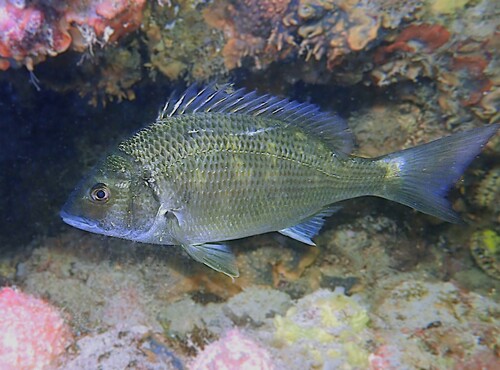
Black Bream
Acanthopagrus butcheri
A silver-bronze icon of Australia's southern estuaries, the Black Bream is a master of adaptation and a favorite of coastal observers. Known for its cautious intelligence and ability to thrive in both salt and brackish water, this resilient fish is a true local resident.
Quick Identification
Size
Typically 25-35 cm (10-14 inches), reaching up to 60 cm (24 inches) and 4 kg (8.8 lbs).
Colors
Silver-grey to olive-bronze on the back, fading to a silvery-white belly. Fins are generally dusky or greyish, notably lacking the yellow tint found in related species.
Key Features
- Deep-bodied with a noticeably arched back
- Dusky-colored ventral and anal fins without yellow pigment
- Blue-ish tinge on the snout of older adults
- Dark spot at the base of the pectoral fin
When You’ll See Them
Geographic range
Where Does the Black Bream Live?
The Black Bream is endemic to the southern reaches of the Australian continent, thriving in the temperate waters of the Great Australian Bight and surrounding coasts. Its range extends from the Shark Bay region in Western Australia, all the way around the southern coastline to Ulladulla in New South Wales, and it is a common sight in the estuaries of Tasmania. Unlike many marine fish, it does not venture far into the open sea, preferring to remain within the safety of river systems and coastal lakes.
Basemap © OpenStreetMap contributors
Behavior
The Black Bream is a highly adaptable and intelligent species, famous among anglers and observers for its cautious, almost 'wary' personality. Unlike many other fish that roam the open ocean, the Black Bream is a true estuarine specialist, often spending its entire life cycle within a single river system. They are social creatures, frequently seen in schools when young, though larger 'trophy' individuals tend to become more solitary and territorial around structure.
These fish are opportunistic and brave when it comes to exploring for food. They are known to move into extremely shallow water—sometimes barely deep enough to cover their backs—to forage among mangroves or over mudflats during a rising tide. In areas with human activity, they are scavengers, often congregating around jetties and boat ramps where they have learned to associate humans with easy meals, despite remaining easily spooked by sudden movements or shadows.
EverydayEarth exclusive
Camera Tips
Capturing Black Bream on camera requires an underwater setup, ideally positioned near structure. Since these fish are highly attracted to 'pylon life,' mounting your camera on a jetty or dock piling is the most effective strategy. Use a wide-angle lens to capture the schooling behavior, and ensure the camera is angled slightly downward to catch them as they forage along the bottom for crabs and worms.
To bring the fish into view of your AI-powered camera, use a 'burley' or bait cage positioned about a meter away from the lens. Oily baits like pilchards or crushed crabs are irresistible to Black Bream. However, be mindful of water clarity; these fish thrive in estuaries where tide changes can stir up silt. Setting your camera to record during the top of the high tide—when the clearest ocean water is pushed into the estuary—will yield the crispest footage.
Because Black Bream are light-sensitive and cautious, avoid using high-intensity white lights at night. Instead, rely on ambient light during the day or subtle infrared for night shots. If your camera setup allows, place it near fallen timber ('snags') or oyster leases, as these are the natural patrolling grounds for larger, blue-nosed adults. During the spring months, you may even capture spawning aggregations where the fish become much more active and less shy.
Similar Species
Species that look similar or are commonly confused with Black Bream.
Yellowfin Bream
Features bright yellow ventral and anal fins and is more common in warmer northern waters.
Tarwhine
Has a more rounded snout and gold longitudinal lines running along the body rows of scales.
Pikey Bream
Found in tropical regions and has a much darker, almost charcoal body with a more prominent dorsal spine.
Frequently Asked Questions
Record Black Bream at your habitat
Connect a camera to start building your own species record — AI identifies every visitor automatically.