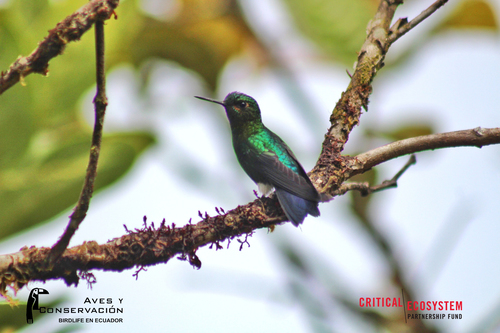
Black-breasted Puffleg
Eriocnemis nigrivestis
One of the rarest gems of the Andes, the Black-breasted Puffleg is a Critically Endangered hummingbird found only on a handful of Ecuadorian volcanic slopes. Famous for its velvety black feathers and snowy-white 'boots,' this elusive bird is a holy grail for wildlife watchers.
Quick Identification
Size
Length: 8-9 cm (3.1-3.5 in); Weight: 4.3-4.6 g (0.15-0.16 oz)
Colors
Males are velvety black with iridescent purple-blue throat and belly patches; females are bronzy-green above with golden-green underparts. Both have signature white leg puffs.
Key Features
- Velvety black plumage with iridescent purple-blue patches (males)
- Distinctive white 'boots' or leg puffs at the base of the thighs
- Short, straight black bill
- Forked tail with dark blue-black feathers
When You’ll See Them
Geographic range
Where Does the Black-breasted Puffleg Live?
This ultra-rare hummingbird is endemic to the high-altitude slopes of the Andes in northern Ecuador. Its extremely limited range is confined almost exclusively to the Pichincha volcano complex and the Atacazo volcano, making it one of the most geographically restricted birds in the world. It exists only in small, fragmented pockets of pristine cloud forest, with no populations found outside of this tiny Ecuadorian corridor.
Basemap © OpenStreetMap contributors
Behavior
The Black-breasted Puffleg is a spirited and highly territorial hummingbird known for its remarkable agility in the thin air of the Andes. These birds are often solitary, vigorously defending specific floral patches or nectar sources from other hummingbirds. While they are small, their presence is commanding as they dart between high-altitude shrubs, their white leg puffs flashing like tiny beacons against their dark bodies.
Feeding behavior involves a mix of 'trap-lining'—visiting a routine circuit of flowers—and territorial guarding. They are generally elusive and sensitive to human presence, though they may visit established nectar feeders in specialized eco-lodges or conservation stations within their very narrow range. Their social interactions are mostly limited to brief, intense chases during the breeding season or disputes over feeding rights.
EverydayEarth exclusive
Camera Tips
Capturing the Black-breasted Puffleg on camera requires extreme precision due to its rarity and high-altitude habitat. Position your AI-powered camera at eye level with native tubular flowers like Macleania or Cavendishia. Because these birds are 'trap-liners,' they follow specific routes; once you record a sighting, leave the camera in that exact spot, as they are likely to return at the same time the following day.
A fast shutter speed or high frame rate (at least 60fps) is essential to freeze the rapid wingbeats and distinct white leg puffs of this species. Since light levels in the Ecuadorian cloud forest can be low and misty, ensure your camera has a high-quality sensor capable of handling low-light conditions without losing the iridescent details of the male's black plumage. Avoid using heavy flashes, as these can startle the bird and disrupt its feeding pattern.
If you are setting up a camera near a feeder in a known conservation area, place the camera approximately 3 to 5 feet away to capture the bird's full profile. Angle the camera slightly upward to catch the blue-purple iridescence on the throat and belly, which only reveals itself at certain angles. Given the misty climate, a weather-proof housing or a protective 'roof' for the camera is mandatory to prevent lens fogging and moisture damage.
Similar Species
Species that look similar or are commonly confused with Black-breasted Puffleg.
Frequently Asked Questions
Record Black-breasted Puffleg at your habitat
Connect a camera to start building your own species record — AI identifies every visitor automatically.