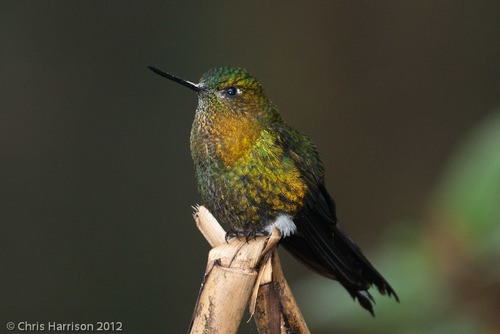
Golden-breasted Puffleg
Eriocnemis mosquera
A shimmering jewel of the high Andes, the Golden-breasted Puffleg is instantly recognizable by its bronzed plumage and whimsical white 'leg warmers.' This hardy hummingbird thrives in the misty cloud forests of Colombia and Ecuador.
Quick Identification
Size
Length: 12-13 cm (4.7-5.1 in); Weight: 5.2-9.2 g (0.18-0.32 oz)
Colors
Lustrous golden-bronze or greenish-bronze body plumage; distinctive snowy-white feather tufts on legs; dark, deeply notched tail; males and females are monomorphic (look similar).
Key Features
- Prominent white 'puff' feathers on the legs
- Shimmering golden-green or coppery body plumage
- Medium-length, straight black bill
- Deeply notched or forked tail
When You’ll See Them
Geographic range
Where Does the Golden-breasted Puffleg Live?
The Golden-breasted Puffleg is a true high-altitude native of the South American Andes. Its core range is concentrated in the central and eastern cordilleras of Colombia, extending southward into the northern and central Andes of Ecuador. Within this rugged terrain, it remains a permanent resident, favoring the lush, moisture-rich environments of the montane cloud forests. While its range is somewhat restricted by its specific elevation requirements, it is considered locally common in well-preserved habitats.
Basemap © OpenStreetMap contributors
Behavior
The Golden-breasted Puffleg is a spirited high-altitude specialist known for its territorial nature. Like many hummingbirds in the 'brilliants' tribe, it is highly active during the day, spending a significant portion of its time defending lucrative nectar sources from competitors. Despite its delicate appearance, it is remarkably hardy, thriving in the thin, cool air of the Andean cloud forests where it can often be seen hovering with precision near tubular flowers.
Socially, these birds are largely solitary outside of the breeding season. They do not form pair bonds; instead, males and females interact only briefly for mating. While they can be bold when defending a flower patch, they are generally wary of human presence, preferring the dense cover of elfin forests and shrubby páramo edges over open suburban gardens, though they will visit feeders located near high-elevation dwellings.
EverydayEarth exclusive
Camera Tips
Capturing the Golden-breasted Puffleg requires a camera with a very high shutter speed to freeze the rapid wingbeats common to all hummingbirds. If you are using an AI-powered trail camera, ensure it is set to 'Burst Mode' or high-speed video. Because these birds are found at high altitudes where light can be filtered through thick mist or canopy cover, a camera with a sensitive sensor or a wide aperture (f/2.8 or f/4) is essential for maintaining image clarity without excessive noise.
Position your camera near native flowering plants like *Centropogon* or *Macleania*. If you are using a hummingbird feeder to attract them, place it in a semi-shaded area to reduce glare off their iridescent feathers, which can 'wash out' the golden-bronze colors in direct sunlight. Mount the camera at eye level with the feeder or flowers, roughly 3 to 5 feet off the ground, and keep the background as distant as possible to create a beautiful bokeh effect that makes the puffleg's white leg-puffs stand out.
Since these birds are early risers, ensure your camera is active by dawn. In the cool Andean mornings, you might capture them 'trap-lining'—visiting a series of flowers in a specific, repeatable circuit. If you notice a bird returning to the same perch between feeds, that is the perfect spot for a secondary camera placement. Use a fast trigger speed (0.2 seconds or less) to ensure you don't just catch a frame of disappearing tail feathers.
Similar Species
Species that look similar or are commonly confused with Golden-breasted Puffleg.
Frequently Asked Questions
Record Golden-breasted Puffleg at your habitat
Connect a camera to start building your own species record — AI identifies every visitor automatically.