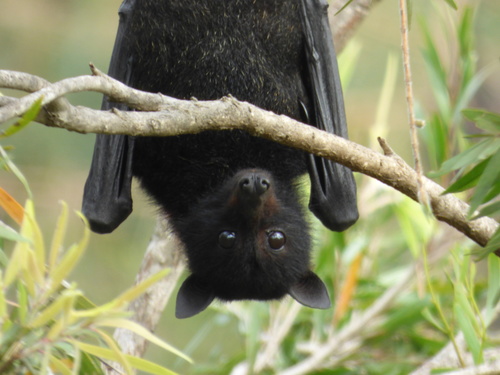
Black Flying-fox
Pteropus alecto
The Black Flying-fox is a majestic 'mega-bat' that reigns over the night skies of Northern Australia. As an essential forest pollinator, this intelligent social mammal is a fascinating frequent visitor to suburban backyards.
Quick Identification
Size
Wingspan up to 1.0 m (3.3 ft); head-body length 25–28 cm (10–11 in); weight 500–1000 g (1.1–2.2 lbs)
Colors
Uniformly jet-black fur, occasionally featuring a subtle reddish-brown or dark chocolate mantle on the neck and shoulders.
Key Features
- Massive wingspan reaching 1 meter
- Short, dense jet-black fur across the entire body
- Fox-like face with large, intelligent eyes and pointed ears
- No visible tail and sharp claws for climbing through canopies
When You’ll See Them
Sightings on EverydayEarth
Jun 28, 2026
Several Black Flying-foxes are hanging upside down from the mesh ceiling and ropes within a large enclosure. The bat in the foreground on the left is particularly active, shifting its position and turning its head to scan the surroundings, while the others remain largely still with their wings wrapped around their bodies.
Jun 27, 2026
In the quiet of night, a flying fox is seen hanging upside down from a branch inside an enclosure. Wrapped tightly in its wings, the bat remains mostly stationary but occasionally shifts its position and turns its head, with its eyes briefly reflecting the camera's infrared light as it looks around.
Jun 25, 2026
A Black Flying-fox hangs upside down from the mesh roof of its enclosure. The bat remains stationary, with its wings folded around its body, while its dark head and vibrant reddish-brown mantle are clearly visible.
Jun 24, 2026
Two bats are hanging from the mesh ceiling of a sanctuary enclosure. The individual on the left is active, shifting its weight and looking around, while the larger one on the right remains stationary, wrapped in its wings. A plush toy is suspended in the center of the frame between the two animals.
Jun 24, 2026
Within an enclosure at a bat sanctuary, a Black Flying-fox hangs upside down from a mesh ceiling. The bat is highly active, shifting its position, stretching its wings, and using its mouth and feet to groom its wing membranes. Another bat hangs more still in the background, while a stuffed toy and a blanket in the foreground sway slightly in the breeze.
Jun 24, 2026
Two large bats are hanging upside down from the mesh ceiling of an enclosure. The bat on the left is active, shifting its head and displaying its prominent reddish-brown mantle against its dark body. The enclosure includes climbing ropes and a mesh wall with sunlight filtering through from the background.
Geographic range
Where Does the Black Flying-fox Live?
The Black Flying-fox is native to the tropical and subtropical regions of Oceania and Southeast Asia. Its core population spans the northern and eastern coastlines of Australia, from Shark Bay in Western Australia across the Top End to New South Wales. Beyond Australia, it is commonly found in the lowland areas of Papua New Guinea and throughout several Indonesian islands, including Sulawesi and Sumba.
Basemap © OpenStreetMap contributors
Behavior
Black Flying-foxes are highly social mammals that congregate in massive communal roosts known as 'camps.' These camps are often located in mangroves or paperbark swamps and can contain tens of thousands of individuals. They are incredibly vocal animals, using a complex language of squawks and chatters to establish hierarchy and defend their personal space within the crowded roost.
As nocturnal foragers, they depart their camps in spectacular 'fly-outs' at sunset, traveling up to 50 kilometers in a single night to find food. They are exceptionally intelligent and have been observed using sophisticated navigation skills to return to the same productive trees night after night. While they can be noisy neighbors in suburban areas, they are harmless to humans and pets if left alone.
EverydayEarth exclusive
Camera Tips
To capture the best footage of Black Flying-foxes, you need to think vertically. These bats rarely descend to the ground, so your AI-powered camera should be mounted high—ideally 2 to 4 meters up—facing a known food source like a flowering Grevillea or a fruiting fig tree. Angle the camera slightly upward to capture them as they glide into the branches or clamber through the foliage using their hooked thumbs.
Since they are strictly nocturnal, a camera with high-quality 'no-glow' infrared LEDs is a must. Standard white flash can startle them and cause their dark fur to appear as a featureless black blob. Set your camera to capture short video clips (15-20 seconds) rather than just stills; the way these bats wrap their wings around themselves or interact with other bats provides much more interesting content than a static image.
You don't need artificial bait, which can actually be harmful to their diet. Instead, focus your camera on 'natural' lures. During hot summer spells, placing a camera near a swimming pool or a garden pond can yield amazing results, as flying foxes will often fly low over the water to 'belly-dip,' licking the water off their fur to stay hydrated and cool.
Finally, ensure your camera's PIR (Passive Infrared) sensitivity is set to 'High.' Because bats move quickly and have fur that insulates their body heat, they can sometimes be missed by less sensitive sensors. A high-speed trigger will ensure you catch the moment they first swoop into the frame rather than just a departing wing-tip.
Similar Species
Species that look similar or are commonly confused with Black Flying-fox.
Frequently Asked Questions
Record Black Flying-fox at your habitat
Connect a camera to start building your own species record — AI identifies every visitor automatically.