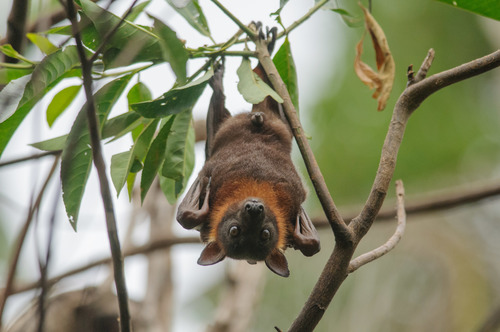
Little Red Flying-fox
Pteropus scapulatus
Meet Australia’s smallest megabat, the Little Red Flying-fox. A nomadic nectar-lover known for its stunning ginger fur and massive social colonies that follow the flowering of the bush.
Quick Identification
Size
Wingspan of 90-120 cm (35-47 in); body length of 20-25 cm (8-10 in); weighs 300-600g (0.6-1.3 lbs)
Colors
Rich reddish-brown to ginger fur on the body; greyish-brown head; wings appear translucent and pale brown when flying
Key Features
- Distinctive reddish-ginger fur coat
- Translucent wing membranes in flight
- Smallest Pteropus species in Australia
- Pointed ears and fox-like face
- Often seen in massive, dense clusters
When You’ll See Them
Geographic range
Where Does the Little Red Flying-fox Live?
Native to the Australian continent, the Little Red Flying-fox maintains an expansive range that covers much of northern and eastern Australia. They are commonly found from the Shark Bay region in Western Australia, across the Top End, and down through Queensland and New South Wales, occasionally reaching into Victoria and South Australia. Because they are highly nomadic, their presence in any specific area is entirely dependent on the seasonal flowering of their favorite native trees, making them seasonal visitors to many suburban backyards.
Basemap © OpenStreetMap contributors
Behavior
The Little Red Flying-fox is the most nomadic of Australia’s megabats, traveling vast distances in pursuit of mass-flowering eucalyptus trees. Unlike other flying-foxes that may stay in one region for years, these bats are true wanderers, sometimes appearing in a town by the millions only to vanish a few weeks later once the nectar flow ceases. They are highly social and form the largest colonies of any Australian bat, with roosts occasionally becoming so heavy with bats that tree branches snap under their collective weight.
These bats have a unique and fascinating way of drinking water. During hot weather or dry spells, they fly low over rivers and pools, skimming the surface to soak the fur on their bellies. Once they fly back to a perch, they lick the water from their fur to hydrate. In residential areas, they are often heard before they are seen, making high-pitched chattering sounds as they compete for the best blossoms in backyard trees at night.
EverydayEarth exclusive
Camera Tips
To capture the Little Red Flying-fox on camera, placement is everything. Since they are nectar specialists, your best bet is to mount your camera high in a tree that is currently in bloom, particularly Eucalypts or Grevilleas. Aim the camera at a cluster of flowers rather than a broad area. Use a strap or a specialized tree mount to get the camera 3-5 meters off the ground, angled slightly downward toward the blossoms where the bats will land to feed.
Because these bats are fast and active at night, set your camera to 'Fast' trigger speed and 'Burst Mode.' They often hover or shuffle quickly between flowers, so a single photo might result in a blur. Capturing 3-5 photos per trigger increases your chances of getting a sharp image of their reddish fur and fox-like faces. If your camera has adjustable PIR sensitivity, set it to high, as bats can be difficult to trigger due to their small body mass compared to larger mammals.
Another excellent strategy is to position a camera near a freshwater source like a garden pond or pool, especially during hot, dry spells. Since they 'belly-dip' to drink, a low-profile camera aimed across the surface of the water can capture incredible action shots. Ensure your night vision or infrared flash is set to 'High' or 'Long Range' to illuminate the bats against the dark sky, and try to keep the camera within 2-3 meters of the target area for the best detail.
Similar Species
Species that look similar or are commonly confused with Little Red Flying-fox.
Grey-headed Flying-fox
Larger body size, darker fur, and a distinct orange collar around the neck.
Black Flying-fox
Much larger and almost entirely black, lacking the reddish-ginger tones of the Little Red.
Spectacled Flying-fox
Features pale fur rings around the eyes and is restricted to North Queensland.
Frequently Asked Questions
Record Little Red Flying-fox at your habitat
Connect a camera to start building your own species record — AI identifies every visitor automatically.