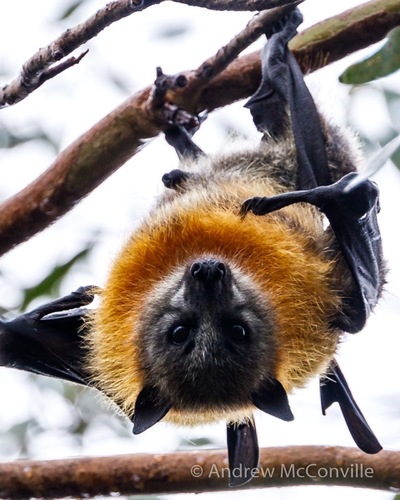
Grey-headed Flying-fox
Pteropus poliocephalus
Australia’s largest bat is a spectacular sight in the night sky, easily recognized by its 'ginger' collar and impressive wingspan. As a critical forest pollinator, having these megabats visit your backyard is a sign of a healthy, flowering ecosystem.
Quick Identification
Size
Wingspan up to 1 m (3.3 ft); head-body length 23–29 cm (9.1–11.4 in); weight 600–1,100 g (1.3–2.4 lbs)
Colors
Light grey fur on the head, a vivid reddish-orange or ginger collar completely encircling the neck, and a dark grey to black body. No sexual dimorphism in color.
Key Features
- Bright orange or ginger collar around the neck
- Light grey fur covering the head
- Fur extends all the way down to the ankles
- Largest bat species in Australia with a fox-like face
When You’ll See Them
Behavior
The Grey-headed Flying-fox is a highly social and intelligent mammal that lives in large communal roosts called camps, which can contain tens of thousands of individuals. They are nocturnal foragers, leaving their camps at sunset in a spectacular 'fly-out' to search for food up to 50 kilometers away. While they have a reputation for being noisy, their vocalizations are a sophisticated form of communication used to defend territory and interact with their young.
In suburban environments, these bats are frequently seen visiting flowering gums or fruiting trees in backyards. They are vital to the Australian ecosystem, acting as 'long-distance' pollinators and seed dispersers for native hardwood forests. While they are generally shy of humans, they are curious and can become accustomed to visiting the same garden night after night if a reliable food source is present.
EverydayEarth exclusive
Camera Tips
To capture high-quality footage of a Grey-headed Flying-fox, position your camera near a known food source rather than a flight path. Look for flowering Eucalyptus or Banksia trees in your yard. Mount the camera high—at least 2 to 3 meters (6-10 feet) up—angled slightly upward toward the blossoms. Because these bats often hang upside down to feed, placing the camera on a branch looking toward a cluster of flowers or fruit will give you the best chance of capturing their faces and the 'thumb' claws they use to maneuver.
Lighting is your biggest challenge since they are strictly nocturnal. Use a camera with high-quality infrared (IR) night vision or 'No-Glow' LEDs to avoid startling them. Set your trigger speed to the fastest possible setting; these bats are surprisingly quick when landing or taking off. A video length of 15-20 seconds is ideal, as it allows you to see their social grooming and the way they wrap their wings around themselves like a cloak.
If you are using a trail camera with a PIR (Passive Infrared) sensor, be aware that bats have excellent insulation, and their body heat might not always trigger the sensor if the ambient temperature is high. Try to position the camera within 3 meters of the target branch to ensure the sensor picks up their movement. During the summer months, you might even capture them 'belly-dipping' in a backyard pool or pond—a unique behavior used to drink and cool down on hot nights.
Similar Species
Species that look similar or are commonly confused with Grey-headed Flying-fox.
Black Flying-fox
Lacks the orange collar and has fur only to the knees, whereas the Grey-headed has fur to the ankles.
Little Red Flying-fox
Much smaller with distinct reddish-brown fur and transparent-looking wings compared to the dark wings of the Grey-headed.
Spectacled Flying-fox
Has prominent rings of pale yellow fur around the eyes, resembling spectacles, and is found further north in Queensland.
Frequently Asked Questions
Record Grey-headed Flying-fox at your habitat
Connect a camera to start building your own species record — AI identifies every visitor automatically.