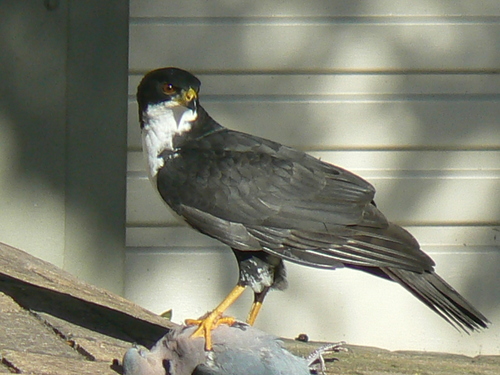
Black Goshawk
Astur melanoleucus
The Black Goshawk is Africa’s premier urban raptor, a master of stealth that has traded the deep forest for the garden canopy. With its piercing red eyes and lightning-fast strikes, it is one of the most thrilling visitors you can discover on your backyard camera.
Quick Identification
Size
Length: 46–58 cm (18–23 in); Wingspan: 77–105 cm (30–41 in); Weight: 450–1,050 g (1–2.3 lbs)
Colors
Adults have black upperparts and either white underparts (white morph) or entirely black underparts (dark morph); distinct yellow cere and legs; adults have striking red eyes.
Key Features
- Large, powerful yellow legs and feet
- Vivid red eyes in mature adults
- Contrast of coal-black back against white or black chest
- Long, barred tail
When You’ll See Them
Geographic range
Where Does the Black Goshawk Live?
The Black Goshawk is a widely distributed raptor native to Sub-Saharan Africa. It is found across a vast stretch of the continent, from the tropical forests of West and Central Africa to the wooded savannahs and suburban landscapes of East and Southern Africa. Its core populations are particularly dense in South Africa, Kenya, and Zimbabwe, where it has expanded its range significantly by utilizing man-made forests and urban green spaces.
Basemap © OpenStreetMap contributors
Behavior
The Black Goshawk is a formidable and highly adaptable predator that has successfully transitioned from deep forests to the leafy suburbs of African cities. Known for its incredible speed and stealth, it is a pursuit hunter that often catches its prey in mid-air. Unlike many other raptors that soar high in the sky to hunt, this goshawk prefers to stay low or perch within the canopy, waiting for the perfect moment to strike with a burst of acceleration.
These birds are notably territorial, especially during the breeding season. They often return to the same nesting sites for many years, frequently choosing tall, exotic trees like Eucalyptus. While they are generally solitary or found in pairs, they have become remarkably tolerant of human activity, often nesting in busy schoolyards or private gardens where they can be observed raising their young despite the hustle and bustle below.
EverydayEarth exclusive
Camera Tips
To capture the Black Goshawk on your backyard camera, focus on 'plucking posts.' These are specific low branches or stumps where the hawk brings its prey to remove feathers before eating. If you notice a pile of feathers in your garden, place your camera 3-5 feet away, angled slightly upward. These birds are creatures of habit and will often use the same plucking post for weeks at a time.
Water is another excellent draw. Black Goshawks are known to be frequent bathers, especially in the heat of the afternoon. Position your AI-powered camera near a large, sturdy birdbath or a shallow garden pond. Because these are large birds, ensure the camera is far enough back to capture their full 3-foot wingspan when they shake dry, which makes for spectacular slow-motion footage.
Since these hawks are incredibly fast, set your camera to its highest trigger speed and use the 'burst' photo mode or high-frame-rate video. If your camera supports AI detection, set it to prioritize 'Large Birds.' They are most active in the early morning and late afternoon, so ensure your camera is positioned to avoid direct lens flare from the rising or setting sun, which can wash out the deep blacks of their plumage.
During the breeding season (typically July to December in Southern Africa), look for them carrying sticks to tall trees. If you have tall Eucalyptus or Pines on your property, mount a camera on a nearby structure or a high pole overlooking the upper canopy. However, always maintain a respectful distance from the nest itself to avoid stressing the birds, as they can become aggressive when protecting their chicks.
Similar Species
Species that look similar or are commonly confused with Black Goshawk.
Frequently Asked Questions
Record Black Goshawk at your habitat
Connect a camera to start building your own species record — AI identifies every visitor automatically.