Black Guineafowl
Agelastes niger
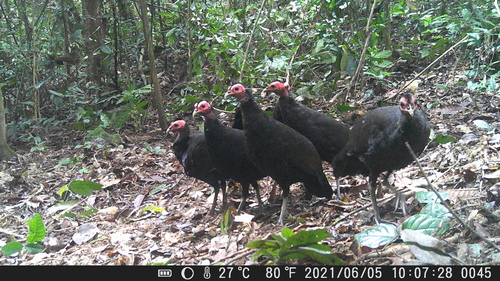
The Black Guineafowl is the reclusive shadow of the Central African rainforest. Unlike its famous spotted cousins, this secretive bird wears a suit of pure ebony topped with a vibrant, bare orange head.
Quick Identification
Size
40–45 cm (16–18 in) in length; weight typically ranges from 600–800 g (1.3–1.8 lbs)
Colors
Uniformly charcoal-black body plumage; bare, unfeathered skin on the head and upper neck is a striking orange-pink to reddish-pink.
Key Features
- Vibrant bare orange-pink head and neck
- Solid black plumage without the white spots typical of other guineafowl
- Lack of a bony casque or 'helmet'
- Strong, dark legs adapted for constant walking
When You’ll See Them
Geographic range
Where Does the Black Guineafowl Live?
The Black Guineafowl is a specialist of the West-Central African equatorial forest belt. It is natively found in the lush heart of the Congo Basin, with its range stretching from south-eastern Nigeria through Cameroon, Equatorial Guinea, Gabon, and the Republic of the Congo, reaching into the northern Democratic Republic of the Congo. These birds are strictly tied to dense, humid forest environments and are rarely found in fragmented or heavily settled areas, making them a true symbol of the African jungle's interior.
Basemap © OpenStreetMap contributors
Behavior
The Black Guineafowl is widely considered the 'ghost' of the African rainforest. Unlike the noisy, gregarious Helmeted Guineafowl found in open savannas, this species is intensely reclusive and prefers the deep shadows of the jungle floor. They are typically found in pairs or small family groups of up to ten birds, moving cautiously through the undergrowth. They are incredibly wary; at the first sign of a predator or human, they will sprint into dense cover rather than take flight.
Socially, they are much quieter than their cousins, communicating with soft, low-frequency contact calls that help the group stay together in the thick vegetation without drawing unwanted attention. Their lives are dictated by the rhythm of the forest floor, where they spend the daylight hours scratching through leaf litter. They are rarely seen in flight, usually only fluttering up to low branches to roost safely for the night away from ground predators.
EverydayEarth exclusive
Camera Tips
Capturing a Black Guineafowl on an AI-powered trail camera is the ultimate challenge for backyard or forest observers in their range. Because they are exceptionally shy, camera placement is critical. Look for 'game trails'—subtle, narrow paths through the leaf litter that suggest frequent passage by ground birds. Setting your camera at a very low height, approximately 6 to 10 inches off the ground, is essential for getting clear, eye-level shots of their unique orange-pink heads.
These birds are sensitive to new objects in their environment. To avoid scaring them off, use a 'No-Glow' infrared camera that emits no visible light when triggered. Camouflage the exterior of the camera with local moss or bark to break up its silhouette. Since they move in small groups, set your camera to 'Burst Mode' or a short video clip (10-15 seconds) to ensure you capture the entire family unit rather than just the first bird that triggers the sensor.
While these birds are hard to lure, you can encourage them to stop by focusing your camera on a naturally occurring food source, such as a fallen fruit tree or an area with soft, damp soil rich in insects. Avoid clearing too much brush in front of the camera, as the sudden open space may make them nervous. A small, natural-looking depression in the ground where you have lightly disturbed the soil to reveal grubs can often keep a guineafowl in the frame long enough for a perfect identification shot.
Similar Species
Species that look similar or are commonly confused with Black Guineafowl.
Frequently Asked Questions
Record Black Guineafowl at your habitat
Connect a camera to start building your own species record — AI identifies every visitor automatically.