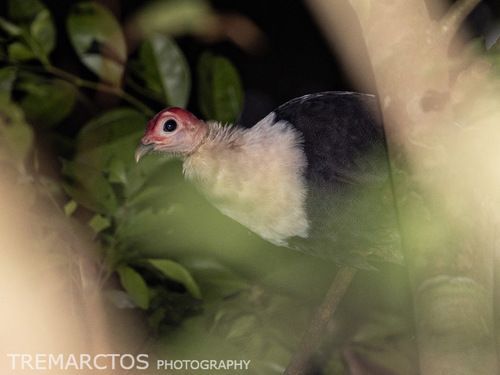
White-breasted Guineafowl
Agelastes meleagrides
Meet the 'Ghost of the Upper Guinea Forest,' a bird defined by its striking white plumage and legendary shyness. Rare and reclusive, the White-breasted Guineafowl is a true prize for any forest-based trail camera.
Quick Identification
Size
40–45 cm (16–18 inches) in length; weighs approximately 0.6–0.9 kg (1.3–2.0 lbs)
Colors
Distinctive white lower neck and breast; black body with fine white vermiculation; bare red skin on head and upper neck; greyish-black legs
Key Features
- Large solid white patch on breast and neck
- Bare, featherless bright red head
- Black plumage with delicate white wavy lines
- Plump, chicken-like body with a short tail
- Dark legs, often with spurs on males
When You’ll See Them
Behavior
The White-breasted Guineafowl is a notoriously shy and secretive bird, spending the majority of its life hidden within the dense undergrowth of primary rainforests. Unlike the more common Helmeted Guineafowl found in open savannas, this species is strictly forest-dwelling. They usually travel in small, tight-knit groups of 10 to 15 individuals, though they are occasionally seen in pairs. Their social structure relies on constant vocal communication, using soft chirps to stay connected as they move through the leaf litter.
When threatened, these birds prefer to run through the forest floor rather than fly, utilizing their incredible speed and knowledge of the terrain to vanish into the shadows. They are terrestrial by day but will fly up to low branches to roost at night for protection from ground predators. Their interaction with humans is extremely limited due to their preference for undisturbed habitats, making them a 'holy grail' for many wildlife photographers and researchers.
EverydayEarth exclusive
Camera Tips
To capture the elusive White-breasted Guineafowl, camera placement is the most critical factor. These are strictly ground-dwelling birds, so your camera should be mounted very low—ideally between 10 and 15 inches off the ground. Aim the lens across a known 'micro-trail' or a small clearing in the forest floor where leaf litter has been recently disturbed. Because they inhabit the dark forest understory, ensure your camera has a high-quality sensor capable of handling low-light conditions without excessive grain.
Lighting is a major challenge in their habitat. Use 'No-Glow' or high-end Black IR flash settings to avoid spooking the flock. A visible red glow from standard infrared cameras can cause these birds to flee or avoid the area in the future. If your camera allows for video, set it to record 20-second clips. The way these birds move—bobbing their heads and communicating with subtle gestures—is much more striking in video format than in still photos. High-speed triggers are also essential, as they can move surprisingly fast when foraging.
For baiting, these birds are often attracted to small piles of native fruits or even generic cracked corn if they have become somewhat habituated to a specific study area. However, the best 'lure' is often a natural water source during a dry spell. If you find a small forest pool or a slow-moving stream, positioning the camera there will significantly increase your chances of seeing the whole flock. Always check that the lens is clean; the high humidity of the rainforest can often cause fogging or 'sweating' on the glass, which will ruin your shots.
Similar Species
Species that look similar or are commonly confused with White-breasted Guineafowl.
Frequently Asked Questions
Record White-breasted Guineafowl at your habitat
Connect a camera to start building your own species record — AI identifies every visitor automatically.