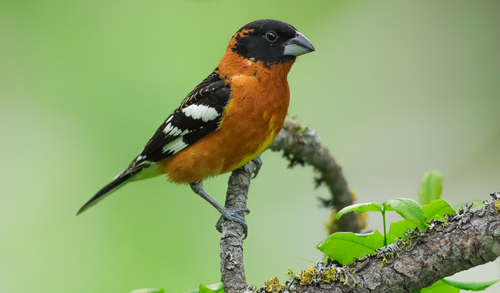
Black-headed Grosbeak
Pheucticus melanocephalus
The Black-headed Grosbeak is a stunning summer visitor to Western backyards, known for its sunset-colored plumage and a song that rivals the finest woodland flutes.
Quick Identification
Size
Length: 18–19 cm (7.1–7.5 in); Wingspan: 32 cm (12.6 in); Weight: 34–54 g (1.2–1.9 oz)
Colors
Males have a black head, cinnamon-orange breast and neck, and black wings with bold white patches. Females and immatures are brownish with heavy streaking and a prominent white eyebrow stripe.
Key Features
- Massive, silver-grey seed-cracking bill
- Bright orange-cinnamon underparts on males
- Bold white wing bars visible in flight and at rest
- Rich, whistling song reminiscent of a Robin
When You’ll See Them
Sightings on EverydayEarth
Jun 22, 2026
A busy scene at the feeding station features a male Black-headed Grosbeak perched at the suet feeder in the center. Around it, several White-winged Doves occupy the lower wooden platform and nearby branches, foraging for seeds. The birds are active, with individuals landing and departing throughout the observation.
Jun 6, 2026
A Black-headed Grosbeak is perched on a tube feeder, using its heavy bill to extract seeds from a port. The bird remains actively feeding against a backdrop of sun-dappled scrub vegetation.
Geographic range
Where Does the Black-headed Grosbeak Live?
Native to the Western half of North America, the Black-headed Grosbeak breeds from southern British Columbia and Alberta down through the western United States into the highlands of Mexico. As a strictly migratory species, the entire population moves south for the winter, primarily settling in the central and southern regions of Mexico. While they are most concentrated in the interior West and Pacific states, they occasionally wander eastward during migration, appearing as rare visitors in the Great Plains.
Basemap © OpenStreetMap contributors
Behavior
Black-headed Grosbeaks are celebrated for their rich, flute-like songs that brighten the canopy of Western forests and suburban neighborhoods. Uniquely among songbirds, both males and females sing, and it is not uncommon to hear them vocalizing while sitting directly on the nest. They move with a deliberate, somewhat slow pace through the foliage, making them excellent subjects for backyard observers once they settle into a feeding routine.
These birds are notably hardy and possess a specialized metabolism that allows them to consume Monarch butterflies, which are toxic to most other birds. In a backyard setting, they are relatively bold but prefer the safety of cover. They are often seen in pairs during the breeding season and may become quite territorial around their preferred food sources, though they generally coexist well with other medium-sized songbirds.
EverydayEarth exclusive
Camera Tips
To get the best shots of Black-headed Grosbeaks, focus your camera on a sturdy platform or hopper feeder. Their large, powerful bills are designed for cracking tough shells, and they prefer a stable surface where they can sit and work through a pile of sunflower seeds. Position your camera approximately 3 to 4 feet from the feeder at eye level to capture the intricate patterns of the male's orange plumage and the female's detailed facial stripes.
Water is an incredible lure for this species. They are enthusiastic bathers and will frequently visit birdbaths with moving water or drippers. Setting your camera to a high-speed trigger or video mode near a shallow water feature will often result in spectacular 'action' shots. Because they can be slightly wary of open spaces, placing your water feature or feeder near the protective 'staging' branches of a large shrub or tree will make them feel secure enough to linger in front of the lens.
Pay close attention to lighting, as the male's deep oranges and blacks can be tricky for some sensors. Avoid harsh midday sun which can wash out the orange tones; instead, aim for the soft, directional light of early morning. If you are using a trail camera, ensure the PIR sensitivity is set to 'High' to catch them as they drop down from the canopy. In the height of summer, capturing them at a fruiting tree like a cherry or serviceberry is a great way to document their natural foraging behavior.
Similar Species
Species that look similar or are commonly confused with Black-headed Grosbeak.
Frequently Asked Questions
Record Black-headed Grosbeak at your habitat
Connect a camera to start building your own species record — AI identifies every visitor automatically.