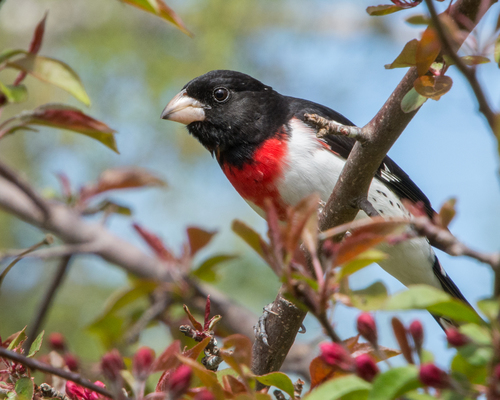
Rose-breasted Grosbeak
Pheucticus ludovicianus
With its striking ruby-red chest and a song that rivals the finest woodland flutes, the Rose-breasted Grosbeak is the 'crown jewel' of the spring migration. This stocky, seed-cracking beauty brings a touch of tropical flair to backyard feeders across the eastern United States and Canada.
Quick Identification
Size
Length: 7.1-7.5 in (18-19 cm); Wingspan: 11.4-13.0 in (29-33 cm); Weight: 1.4-1.7 oz (39-48 g)
Colors
Males have a jet-black head and back, white underparts, and a brilliant rose-red triangular patch on the breast. Females are streaky brown and white with a bold white eyebrow stripe.
Key Features
- Large, pale, triangular seed-cracking bill
- Brilliant rose-red chevron on the male's white breast
- Bold white wing patches visible in flight
- Prominent white eyebrow (supercilium) on the female
When You’ll See Them
Sightings on EverydayEarth
May 13, 2026
A male Rose-breasted Grosbeak lands on the edge of the tray feeder. It spends several seconds looking around and inspecting the sunflower seeds before beginning to feed, occasionally turning its body to show the white spotting on its dark wings.
Jun 13, 2026
A female Rose-breasted Grosbeak and a male House Finch are perched together on an orange fruit feeder, both busy eating grape jelly. The larger grosbeak dominates the left side of the frame while the smaller finch feeds on the right. After a few moments of feeding, the finch flies away first, followed shortly by the grosbeak.
Jun 4, 2026
A Rose-breasted Grosbeak, appearing in its brownish female or juvenile plumage, forages directly in the feeder tray. It uses its large bill to sift through the sunflower seeds and corn, looking around alertly between bites.
Jun 1, 2026
A female Rose-breasted Grosbeak is perched on the edge of the feeder tray, diligently sorting through the seeds and feeding.
May 22, 2026
A female Rose-breasted Grosbeak is perched on the rim of an Oriole feeder, feeding on grape jelly and occasionally looking toward the camera.
May 19, 2026
A female Rose-breasted Grosbeak hops onto the edge of an oriole feeder. It looks around and probes the area near the orange slices, eventually causing one of the slices to tip over and shift position as the bird moves out of the frame.
Geographic range
Where Does the Rose-breasted Grosbeak Live?
Native to North America, the Rose-breasted Grosbeak spends its breeding season across southern Canada and the northeastern United States, stretching as far west as the Great Plains. These long-distance travelers are highly migratory, fleeing the northern chill to spend their winters in the tropical climates of Central America, northern South America, and the Caribbean. Because of this vast range, they are a highlight of the spring migration for birdwatchers across the eastern half of the continent, appearing suddenly in backyards as they head toward their forest nesting grounds.
Basemap © OpenStreetMap contributors
Recorded on EverydayEarth
Behavior
The Rose-breasted Grosbeak is often described as a 'refined' visitor to the backyard. Despite their heavy, powerful bills, they have a remarkably sweet, melodic song that sounds like a robin who has taken professional singing lessons. They are primarily foliage gleaners, moving through the canopy of deciduous trees to find insects and fruit, but they are also famous for their calm and methodical demeanor at bird feeders.
Socially, they are somewhat territorial during the breeding season but can be found in small groups or 'charms' during migration. They are known for their distinct 'chip' call, which sounds like a squeaky sneaker on a gym floor. Interestingly, both males and females share incubation duties and will even sing to each other while sitting on the nest, a rare trait among songbirds that usually stay silent to avoid attracting predators.
EverydayEarth exclusive
Camera Tips
To capture the Rose-breasted Grosbeak on your AI camera, focus your efforts on the 'shoulder seasons' of May and September when they are moving through suburban areas in high numbers. During the breeding season, they prefer the high canopy, so bringing them down to eye level requires a reliable food source. A hopper or platform feeder filled with black oil sunflower seeds or safflower seeds is their primary draw. Place your camera roughly 4 to 6 feet away from the feeder at a slight downward angle to capture the brilliant red 'rose' on the male's breast without the bird appearing as a dark silhouette.
Water is an equally powerful attractant for this species. These birds are frequent bathers and will visit birdbaths that feature moving water or drippers. Setting your camera near a shallow stone basin with a solar-powered fountain can yield spectacular footage of their vigorous splashing behavior. Ensure the camera is positioned to catch the light from behind you (facing north or south) to prevent the white belly of the bird from 'blowing out' or overexposing in the bright afternoon sun.
Since Grosbeaks can be slightly more cautious than bold species like Blue Jays, use a camera with a fast trigger speed or a 'pre-roll' feature to ensure you catch them the moment they land. If you are using an AI-powered camera, set it to prioritize 'Bird' detection and consider a high frame rate (60fps) to capture the fluid motion of their wings and the way they manipulate seeds with their thick bills. Because they are early risers, ensure your camera's low-light settings are optimized for the first two hours of dawn when their activity is most frantic.
Similar Species
Species that look similar or are commonly confused with Rose-breasted Grosbeak.
Black-headed Grosbeak
The western counterpart; males have cinnamon-orange breasts and collars instead of rose-red and black.
Purple Finch
Much smaller with a notched tail and raspberry-red wash across the head and back, rather than a single chest patch.
Northern Cardinal
Features a prominent head crest and all-red (male) or tan (female) body, whereas the grosbeak has a black-and-white pattern.
Frequently Asked Questions
Record Rose-breasted Grosbeak at your habitat
Connect a camera to start building your own species record — AI identifies every visitor automatically.